I recently read the beautiful book The Serviceberry, and in it, author Robin Wall Kimmerer (perhaps you were also enthralled by her book Braiding Sweetgrass?) says “I’ve always believed that those who have more joy win”.
Photo of Black caregiver and child, feeling joy, by Sasha Kim
This reminded me of the many quotes and talks and books I’ve been encountering from Black female (some also 2SLGBTQIA+) writers, sharing the idea of rest or even joy as resistance. I’ll confess I haven’t given bell hooks their due yet (I KNOW, I have work to do), but contemporary writers and speakers usually attribute this line of thought, in part, to bell hooks.
I’m writing this after spending an exhausting hour and a half processing the news, reaching out to my reps, and posting to Facebook, where I am finding it increasingly challenging to spend any time without feeling miserable. I think it’s partly the addictive algorithm, partly the way we’ve gone from seeing friends’ posts to seeing advertisements, and partly that the news is just so abysmal and divisive right now.
After all, people are dying, people are being deported, culture is being canceled. In addition to executive orders doing horrendous things, including consolidating power to a level never before seen and clearly setting us up for a dictatorship and lying to the world about Ukraine and their president, I read a post from a trans man and pastor (and friend of a friend) who, after having a passport affirming his male gender identity for the past ten years, renewed his passport only to see himself listed as female (“F”) on the new passport. Other posts are showing the dichotomies, where some nonprofits are no longer providing gender-affirming care and others (as well as the Army) are proceeding as usual, ignoring the orders from above.
So yes, I’m fighting. I hope you’re doing what you can to also support human rights, wherever you are.
But I want to also encourage you to follow Robin’s suggestion. Find more joy. Explore joy. Joy is rebellion, resistance, and revolution!
We resist when we enjoy a movie or a dinner or a walk with our same-sex partner.
We resist when we savor a cup of coffee or tea while looking at a beautiful view.
We resist when we hug, or dance, or laugh.
We may be in extremely challenging times, but if you’re able to stop and read this, I’ll bet you’re also able to find joy. Smell a candle. Hold someone’s hand. Make eye contact with a stranger. Savor a delicious food.
One benefit of making time for joy, in addition to resisting the misery that some out of touch billionaires would want for us, is that feeling joy is also grounding. All of these exercises I mentioned, when entered into with an intention of connection, wholeness, or just full presence, help to ground us in the here and now.
And when we keep ourselves regulated and ground ourselves in the present, we are healing ourselves, and helping ourselves to show up in the best ways we can for ourselves, for our families, for our communities, and for the world.
Monday I offer my Mental Fitness for Musicians class again. It’s absolutely a joy to be able to help musicians to recognize the sabotaging thoughts that get in the way, both in making music and in life and career as a musician more generally, and learn tools to work through the fear, the anxiety, and become more effective musicians, and more JOYFUL musicians, as a result.
If you know a musician who’d benefit, or you’re one yourself, I’d love to see you there.
But wherever you are, and whatever you do, I want to encourage you to be present to joy, and cultivate it. Even when the world collapses around us. If you’re finding joy, you’re winning.
In the world we’re living in, with politics and climate change and humanitarian crises filling our brains and our neighborhoods and our news feeds, I could not be more grateful to be nearly three years into my mental fitness training. What began as a curiosity after six months of intense work to reign in my growing anxiety turned out to be the missing tool in my client work and in my own mental health, and I couldn’t be more thankful for it – especially right now. Today I’d like to share how I found mental fitness and the difference it’s made in my life.
Photo of a person with a cloth headband and simple dress with their back turned to the camera, looking out at a beautiful nature scene by Anastasia Shuraeva
Until my mid-thirties, I didn’t believe I suffered from anxiety. While I was diagnosed with and treated for “depression” as a busy early teen who’d started falling asleep in her classes and after school (in part due to the side effects from my allergy medication), I did talk therapy for a year and was told I was fine, basically, and the sessions stopped, because I was no longer falling asleep all the time and seemed functional and able to handle my activities again.
My life up until that point involved a major identification with the word “busy”. When asked how I was doing, I said I was busy. I was in multiple theater productions (my record was three at a time), taking piano lessons, starting clubs and singing in choirs. I stopped dance lessons mid-way through eighth grade as my theater passion took over (and I’d recently given up dance competitions, which is another article unto itself), but I had added voice lessons into the mix by high school and was also required to participate in three sports or athletic programs each year at the private day school I attended.
So yes. I was busy. And this identification with the word “busy” continued through high school, into college, and into my twenties, where any feelings I had of overwhelm or extra adrenaline or a racing heart etc. were labeled as “busy” at best and otherwise ignored. And when my body started showing signs of chronic health conditions, I pursued diagnoses for physical conditions without recognizing that there might be mental conditions worth exploring too.
It wasn’t until I figured out how to support my husband’s dream (traveling as a touring musician) by having the two of us buy a used RV and travel the United States that things started to shift. I relied on adrenaline and discipline and problem-solving to get through the transition, even in the face of my newer symptoms of fatigue, but by the time we’d been on the road for six months or so, things began to shift. Without a theater company to run, with minimal lessons to teach and nowhere to physically be (unless we wanted to), my mind began to open up, and I found myself asking questions I hadn’t really delved into deeply and from a wise state of mind before.
The questions looked something like these:
Why have I been so successful as a creative, and yet I’ve never earned more than $50,000 in a year?
What are my beliefs around money? Around success?
Where do I want to be in ten years? In twenty?
Who am I if I’m living a simpler life?
What does community mean to me?
Who are really my friends? Who are the friends who believe in me, even when I don’t have anything to offer them but my friendship?
As I began pursuing personal development for the first time, through programs and books and podcasts and an accountability group, I also was living with my husband in very close quarters on a daily basis for the first time. As he worked through his own mental health challenges, I started to see signs that I may also be living with anxiety for the first time. I began occasionally getting panic attacks – and they’d be triggered by my husband’s own struggles to regulate. I began to see with clarity my own signs of codependency and my struggles to maintain boundaries and protect myself from taking on other people’s emotions.
In the midst of these studies, COVID hit, and as Ross and I were prepping for a move to Canada in light of the uncertain political situation and fears that we wouldn’t be able to maintain a unique lifestyle that we loved if we lost our rights to affordable health care and control of our own bodies, we learned to work through new fears and anxieties for the future.
My body and mind were incredible to me during this time. I was working more hours than ever in my online businesses at the same time that I was overseeing a move to Canada, which felt like a fulltime job in itself.
Is it any wonder that by the time we got settled into our new Canada apartment, maybe two months in, my anxiety kicked into overdrive?
I finally felt safe, settled, and like I could relax. We’d gotten what we’d worked so hard for. We’d even crossed the border when such travel was still very restricted, especially on Prince Edward Island. And with this sense of safety and calm, my body said, ‘FINALLY!”. My anxiety rose to the top and spilled out all over the place. It was something like the way athletes get sick after the big competition or students and teachers get sick on vacation.
I was having several anxiety attacks a week. Driving became especially triggering. It was when I noticed it was starting to get in the way of my work that I sought professional help. I went to a mental health clinic and got on the list to see a psychologist. I signed up for Betterhelp to have a more affordable option than the going rate, and I went through one mediocre therapist on that platform before finding someone who had a lot to offer me. After several months on the wait list, I saw an in-person psychologist on PEI’s dime, who unfortunately didn’t seem capable of helping someone as high-performing as me. (She didn’t know what to do with me. Sound familiar to anyone else?) I completed a local anti-anxiety program called ICAN, which gave me excellent practice with anti-anxiety tools like body scans, 5 4 3 2 1, breaking anxiety-producing tasks into smaller pieces and many more.
In other words, I had a ton of support, which I’m grateful for. And I am sure it all helped, especially the anti-anxiety program, to get me through the worst of it. As I did the work, I started to observe myself going weeks and eventually even months between panic attacks.
And then, thanks to a fellow life coach, I discovered Positive Intelligence.
I took advantage of a free program for active coaches. Seven or so weeks of training in mental fitness, led by coach Shirzad Chamine and based on the most cutting edge science and research. We were required to maintain an accountability group and do daily check-ins with each other as part of the process, in addition to weekly group meetings over Zoom.
I entered the program skeptical that anything free could be that transformative. But I was soon a convert. My husband noticed differences in me too. When it ended, I knew I was signing up for further study and to begin training so I could bring mental fitness into my coaching practice.
There’s a lot about Positive Intelligence that resembles the personality study I’d been doing using the Enneagram since 2019. But there are a lot of distinctions too. While my Enneagram work had shown a brilliant light on where I was trapped in patterns of behavior, I hadn’t made significant progress in improving that behavior and growing toward a healthier way of being. (I had, however, developed a lot of compassion and understanding of how to be in better relationship with my family and friends and my husband – some major wins!)
With my new mental fitness tools and a daily commitment to practicing them (thanks in part to the genius Positive Intelligence app included in my study), things started to improve for me really quickly.
I became calmer in the face of stress. I became less likely to get triggered by my husband or a family member or a member of my chorus. I became better able to tap into a wiser, bird’s eye view perspective of my life. I became happier, more easygoing, and a more effective coach, partner, friend and family member.
And over and over again, my clients who chose to study mental fitness with me also were reaping the benefits. They became less reactive, more able to handle grief, better able to get things done (from creating and living by a budget to making phone calls or regulating their own anger and anxiety).
For me, and for so many in my work, mental fitness has been the missing piece. Instead of continually watching themselves repeating patterns but struggling to break free of them, they were able to be more effective and efficient, spending more time in that wiser part of their brain and quieting the negative and sabotaging parts of it. They were happier. And they got to benefit from a more healthy and regulated coach better able to guide them.
With hindsight, I can see that the big piece missing in my own Enneagram studies in the first several years was a commitment to a contemplative practice. At most, I’d dabbled in meditation, and while I went through periods where I got out in nature daily while we were RVing (often for hours at a time), I didn’t recognize it for the meditation that it was, or that it could have been, if I’d taken the podcast out of my ears and really tuned in to my surroundings. Until I joined Enneagram trainings and workshops (rather than simply reading books or listening to podcasts), I wasn’t clear on how essential it is to pair Enneagram work with meditation and other tools. By the time I began doing that that, thankfully, I’d incorporated Positive Intelligence into my life. All of sudden, I was growing mental muscles. My mental fitness and Enneagram work began to support each other.
I remember a few years back, sharing with delight an incident from earlier in the week with my first Enneagram cohort.
At the time, I had a plastic bin next to my bed, and on it, I had a humidifier. I also had a variety of different possessions, including a book, as I was using the bin as a night stand. On this particular evening, I’d fallen asleep and reached over to grab something, and I hit water. Everywhere. Everything on the stand was soaked.
Prior to my Enneagram or mental fitness studies, I would have been hit with a wave of self-revulsion for having made this mistake. My inner critic would have kicked into high gear. And then I would have been angry, jumping into action without stopping to think and cleaning all of it up myself. If at some point down the line I had thought to ask my husband (who was still wide awake) for help, I would have done so in an angry, frustrated state. When met with that heightened, angry and panicked state, my husband would have responded with his own saboteurs, and I know from past experiences this would have led to us both triggering each other and lengthening the process until we could each calm down, forgive as needed, and come to bed and fall asleep.
Instead, I felt the water, realized I was very close to sleep and didn’t want to wake up and ruin that, so I called out to my husband.
“Ross, can you help me with something?” I calmly asked. He came in, happy to assist, be helpful, and answer my calm request. I explained the situation and asked if he could help me since I was almost asleep. He agreed. Given that he struggles in those moments to know what to do, I then began making requests. “Can you go get a towel please?” “Can you put this over there?” I talked him through it, but did so calmly, lying in bed, and trusting him to figure out details of where to hang towels or set items to try.
And when all that was done, I simply rolled over and went back to sleep.
Nowadays, even in the face of this wild rollercoaster of a world, I am extremely grateful. For calm. For days where I am seldom, if ever, thrown off. Even in the face of hard things, it’s the rare day when I have to work hard to stay regulated. I’m able to preemptively do my mental fitness exercises long before a panic attack. And I am healthier, kinder, and more whole in my responses to the world.
Do you have a mental fitness practice? Want to learn more about the saboteurs that are keeping you from living your best life, day in and day out? Imagine what’s possible for you in your relationships, your career, and across your life with this change! It’s never too late to find more joy in your life.
Photo by Jeff Stapleton is a person holding a cardboard sign reading “WHAT NOW?”
We’re living in uncertain times, friends. The news is fast and furious and can change from moment to moment and day to day. So today, I wanted to explore what we can learn from this uncertainty.
In a recent Betterhelp article, they define liminal space as “ a transitional or in-between area that evokes feelings of ambiguity and unease, often occurring during times of change.”
Liminal space is also much of the subject in Suzanne Stabile’s The Journey Toward Wholeness, a book I’ve read several times and that we’re currently studying in one of my Enneagram groups.
I think of liminal space as the in-between, where it feels like nothing is certain. You know where you’ve been, but it’s not where you are now, and it’s not where you’re headed….well, you may not even know where you’re headed. Liminal space can invite you to question everything, including your need to question entirely.
If you’ve graduated from school but haven’t found a job, you’re in liminal space. If you’re in a relationship with someone that doesn’t have a name yet, you’re in liminal space. If you’re grieving for a loved one who is ill but hasn’t died yet, you’re in liminal space. If you’re building a business or working on a project and a lot of the details are fuzzy and you’re not sure where exactly you’re going to wind up, you’re in liminal space.
The uncertainty of the political situation (and thus, the living conditions of the people there) in the United States is undoubtedly liminal space. Even if we have hunches on what will unfold in the weeks and months and years to come, the vast majority of us may be feeling uncertain: uncertain of the time table, uncertain of the outcome, and perhaps uncertain of our role to play or even what’s to become of us.
Let’s acknowledge that that is a lot to carry. Liminal space isn’t easy. Richard Rohr has also said he believes it is the most teachable space. We have so much to learn in uncertain times, if we choose to be open to that learning.
If you’re feeling the “ambiguity and unease” of liminal space, I’m so sorry. It’s really hard. I hear you. I hope you have people you trust and places to find comfort during these challenging times. I wish I had all the answers and enough spaces to keep everyone safe from the dangers around us right now.
I do a lot of offering practices here, and I certainly could do that today. If that’s what you need, I’ll remind you to take time for self-care, whether that means social media breaks, calling your reps, finding joy, or just taking a shower or having a nourishing meal.
But today, I’ll focus on some lessons that uncertainty is teaching me right now, or at least trying to teach me, if I choose to listen.
I can’t control everything. In fact, most of it all is out of my control. I might as well let go and learn to surf the waves, because the illusion of control is on full display right now.
I don’t know the time table. Of my business, of my life, even of the Trump administration. So that offers me opportunities to prioritize what matters most right now and let go of my expectations.
Letting go of expectations is a huge lesson I continue to work on. Uncertainty shows me that in spades.
I’m not the only one feeling uncertain. I’m a part of a much larger community. And finding ways for that community to come together, and embracing those opportunities, is an incredible opportunity. What’s possible, if we get through this?
In the midst of uncertainty, I see even more, day to day, just how important relishing the present moment is. Enjoy that coffee. Listen to your favorite song. Dance, whether people are watching or not. Enjoy the sunshine through the window or on your face. Nothing is promised.
While so much is uncertain, the things that aren’t can stand in stark relief to the uncertainty. Love and relationships mean more somehow when the world is in turmoil around us.
Gratitude is an ever-important practice to me in the face of uncertainty.
If this resonates, I want to encourage you to consider your own experiences right now. What is uncertainty teaching you?
And if you’d like a safe space for asking these questions and supporting each other and our growth in times of uncertainty, I’d love for you to join my next Enneagram group. Reach out to me to sign up, or check out my next Enneagram introduction to learn more about the Enneagram and get a sense of whether you’d like to work with me.
This week in my inbox, Ruth Schalkhauser Tower of Inner Sky Living shared a reflection on leaving room for alternate positive realities. She reflected on how much energy she and her family put into negotiating a change in situation for her mom, only to find out, after much worry and planning on their part about how she’d take it, that mom was already thrilled about the upcoming change in circumstance.
Can you relate to that? Have you ever started making phone calls or gone on an endless anxiety loop, forecasting potential outcomes from something you are really upset about, only for it to turn out to not really be a big deal at all? Or, in fact, maybe it ended up being the best thing that ever happened to you!
Maybe it was a job you didn’t get, or a job you lost.
Maybe it was the relationship you tried so hard to save, but it was that relationship ending that led you to your current partner, or a career change, or to meeting your best friend.
Maybe not being able to come up with the money to buy the house or start the business or go to the school ended up being a gift in disguise.
I love this concept, and particularly her phrase of “alternate positive realities”. It reminds me of a term we use frequently in my mental fitness work: the sage perspective.
The sage perspective, in essence, says “who knows what is good, or what is bad?” The sage perspective says that if we are open to it, we may actually find that something we perceive as a negative now could be a net positive for us, or it could at least have positives in addition to the negatives. It doesn’t deny the negative consequences of what happened, but it asks us to consider the possibility that there may be positives from it that we may not see yet.
One way that I find makes it easier, at least when I’ve done my mindfulness exercises and gotten myself into my sage, wise part of my mind, to deal with fear and anger and sadness and discomfort from news headlines or other life stuff is to remember that I can hold space for the positive possibilities.
Perhaps this awful thing will cause people to see so-and-so for who they truly are.
Perhaps this will inspire bigger and bolder action that is transformative, positively, in the long run.
Similarly, perhaps this stressful or challenging task I have to do is preparing me to be more resilient and better able to handle future challenges down the line.
When we create space for positive possibilities, we don’t erase hurtful or problematic or even evil behaviors. But we can create space for finding the good. As Mr. Rogers used to say, we can look for the helpers.
P.S. Want to learn more about the sage perspective? Book your saboteur assessment feedback session here.
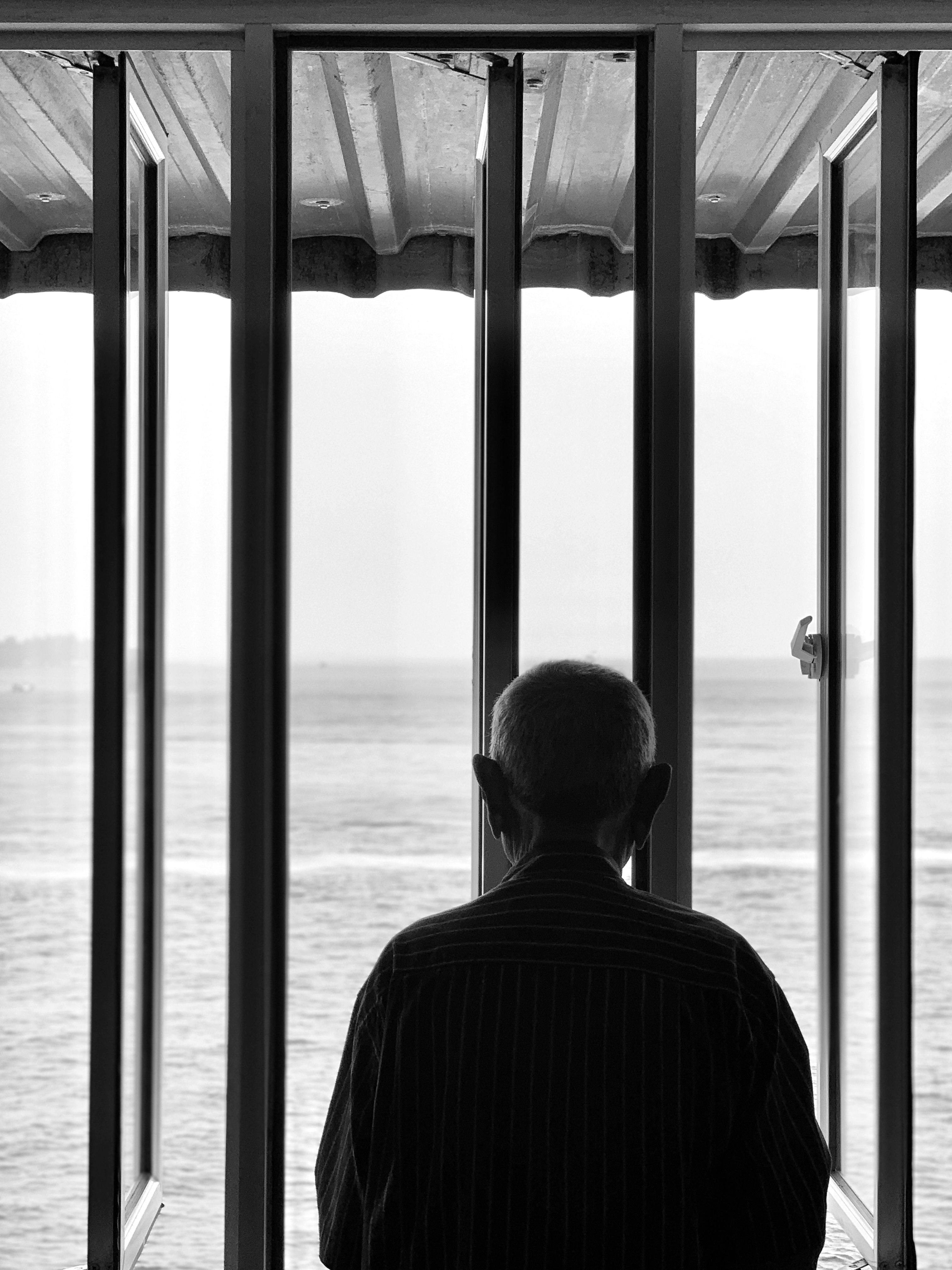
Photo of an elderly man staring at the sea through bars by Muhahmadhu Areesh
TW: for a frank conversation around my own struggles with food and references to diet culture
I’ve been studying the Enneagram for more than five years, and because of that, most of what I’ve studied feels quite ingrained and accessible. But with anything we learn, I think, there are layers, and as we go through new situations in our life and move further along our path (hopefully toward self-actualization), life has a tendency to throw us the same types of situations again and again, in hopes, perhaps, that we’re ready for a new lesson and can grow further as a result. A mentor of mine recently described this idea as a spiral path for growth, and I know that isn’t a new concept for many of us.
My relationship with food, of course, goes back much farther than my relationship with the Enneagram. My own relationship with food is complicated, with past experiences and challenges around food security, trust, and control. Add to that a hefty dose of diet culture in the 80s and 90s and throw in the fact that in the past eight years, I’ve realized I can’t eat gluten and have some other food sensitivities, and you’ve truly got a recipe for food issues, to say the least.
I could share a number of stories about the effects this has had on my life, and about how many therapy and journaling sessions I’ve devoted to it, but I had a particular experience this week that I found absolutely fascinating and couldn’t resist sharing.
Last night, while talking to Ross (my husband), I said I wanted to open the mint chip ice cream we had in the freezer and have some for dessert. He was supportive, of course. I’d purchased it on sale (it’s my favorite Chapman’s flavor) and I was looking forward to it.
Perhaps a half hour after we chatted, I realized I hadn’t yet gotten up from the table to get myself some ice cream. I washed my hands, grabbed a bowl and spoon, removed the ice cream from the freezer, removed the layer of plastic wrapped around the carton, and began scooping myself ice cream. The bowl isn’t especially large, as it fits in the palm of my hand, but it easily fits a lot of ice cream in it. I remember scooping some, and then more, and then more so it went over the top of the bowl, and then filling in some of the gaps, and then I’m sure I had my inner critic chime in that it was plenty and I’d want some later so leave some for the rest of the week. I put away the carton and grabbed my bowl and spoon.
It wasn’t until I set the ice cream down on the table that I looked at it and thought to myself, why is there so much ice cream in my bowl?
Common reasons I might have told myself I was having a large portion of ice cream in the past have included:
I’m really hungry
I’m having one of those days where nothing satiates me…ice cream will
I need more protein today (yes, that’s a real reason I’ve given myself)
I don’t want to leave a little bit in the carton
It’s a special celebration day
I’m at an ice cream place I won’t be back to for a while (or ever), so enjoy it now
This ice cream place is seasonal and closing soon – make the most of it
I’m having a tough day. Ice cream will make me feel better
I’m sure there are others as well. But do you know what I realized last night?
I hadn’t had ANY of those thoughts. Because I actually hadn’t stopped to think. At ALL. I’d had the gut impulse/light bulb moment/memory of my conversation with Ross which then sent me into the kitchen to get myself ice cream.
And then I brought it to the table. Then, and only then, did I look at how much ice cream I’d given myself and think, hmm, I’m not especially hungry. I’ve got some healthier habits I’m working on. I would have even been happier with a smaller bowl. Why in the world did I give myself so much ice cream?
And the answer, clear as day, that came to me, was because I hadn’t stopped to think.
At all.
So, if that isn’t making sense to you, congratulations! You’re probably not an 8, 9, or 1 on the Enneagram. You may not be a dependent number (a 1, 2, or 6) either.
These three numbers, 8/9/1, are in the “gut” or “anger” or “rage” triad. Part of what makes us unique is that we are dominant “doers”. We all rely heavily on “doing” as we go about our day, with different flavors for each number. As a 1, I’m predominantly “doing” when I am in my automatic, auto-pilot part of my being (which is most of the time, for most of us), with this doing fed by how I am feeling about things, though I may not be self-aware enough to be able to articulate the feeling underneath it. When stressful things happen and I feel things, I react to my feelings by doing. But the main thing here, when we’re in this triad, is that we are doers. We are “doing dominant”.
(Side note – 8s are doing dominant, supported by thinking, and 9s would be both doing dominant and doing repressed, but that’s a story for another day.)
Now, this isn’t a bad thing about myself; it just is. But the other piece of this puzzle is that as a member of the dependent stance (made up of 1s, 2s, and 6s), I am by definition thinking repressed. This means that I am less likely to do productive thinking than the members of the other two stances.
Members of the dependent stance are certainly thinking a lot, perhaps even more than others, but that doesn’t mean our thinking is necessarily productive. We are defined by the fact that it is a big challenge for us to bring up productive thinking, at least if we haven’t done a LOT of work.
So, as a person who thinks of herself (and is thought of by others) as a pretty smart person, I’ve had to wrestle a lot with how repressed thinking shows up for me.
And last night, my goodness. Is that not a perfect example of it?
There were so many times along the path from refrigerator to table where I could have stopped to think: Do I want a small amount of ice cream, or a large one? How hungry am I right now? I’ve got some health goals for the future – should I consider those right now? Am I having a strong craving? How would I feel if I didn’t eat ice cream tonight?
My friends, I thought none of those things. I simply got myself a big bowl of ice cream.
And honestly, if I hadn’t done a lot of work on myself, between studying the Enneagram and mental fitness (which has been my best tool for slowing down these auto-pilot moments), I don’t think I would have even noticed.
(This is also, more generally, a perfect example of the kind of automatic responses and habits built into our personality that require a practice of non-judgmental self-observation to be able to recognize it and potentially make another choice. The Enneagram and mental fitness are both beautiful tools for this.)
Of course, as soon as I observed myself at the table, it got me thinking. What factor has this behavior played when I’ve worked on losing weight? What factor has this played in changing my habits to healthier ones? If I could gain more awareness in this moment, perhaps even long enough to do a short mindfulness exercise, could I eat less each night? How would that feel?
I’ve let go of wanting to be a particular size, for the most part. My only holdout is a couple of beautiful dresses I will likely never be able to wear again. But I think I’m going to be okay with that. However, I want my future self to be as fit as I am currently. And I’ve realized recently, in part influenced by the book Outlive, that if I want to be this fit at 60, or at 80, I need to become super-fit NOW. Because our bodies have a tendency to lose muscle, and lose strength, lose stability as we age, the only way to set myself up for a healthy retirement is actually to get MORE fit than I would otherwise care to right now.
Obviously, to even think about doing that requires some privileges, and I’m not fully convinced if this is even a realistic goal for me in my life right now. But I do have it in the back of my mind as I explore steps I can take, and habits I can form, moving in that direction.
And I guess what I’m saying is, we talk about mindless eating. I don’t do that anymore. My eating is truly mindful. I savor each bite or at least one bite of each food I have on my plate, and I truly take my time and enjoy my meals. But only now am I aware of mindless plating!
Have you observed yourself in moments like this? If you’ve studied the Enneagram, did it teach you anything about your own habits you’d like to share?
This week has been busy, and honestly, this year so far has been too. I’m feeling myself simultaneously caught up in the energy of a new year, all the feelings of possibility (real or imagined) that that entails, while also facing a particular brand of challenge and potential stress that has historically been a major issue for me.
I have so much to be grateful for, to be clear. In addition to the majority of areas of my life feeling fairly secure and in a beautiful place, I’m well aware of the privileges I have in even being able to make these plans and work on these types of challenges, when so many nearby and around the world are worried about the essentials – am I safe? Do I have a place to sleep tonight? Is there food on the table? Is there a table? Are my loved ones okay?
But as you may relate to, it’s still quite easy to get caught up in your own challenges, even when they’re not as challenging as someone else’s.
One of the things I’ve been working on this week, because of this particular “challenge” I referred to above, is on two things, as I described in my Enneagram Book Club meeting last night.
The first thing is that I’m working to keep my attention on all the good stuff, the majority of the time. Focus on gratitude for all the stuff that’s pretty darn awesome in my life and even in the lives of others. I have so much to be grateful for, in so many areas. And while there are times when I get troubling news or am handed a surprise and need to spend some time processing my emotions, most of the time in my day to day, I get to choose where my focus is. And if I choose joy (as I have often spoken of), it’s likely that my day, and the day of those I encounter, will be better because of it.
The second, complementary thing I am working on right now, is being able to work on the “challenge”, the hard thing, without bringing negative emotions into it. This is something that my Enneagram work helps me with, but I think it’s my mental fitness practice, more than anything, that has me in a great mindset for this. Instead of anxiety about the outcome of what I’m doing, or anger at the situation I am facing, I’m exploring what it feels like to be curious and to just get stuff done. Can I set aside the critical and sabotaging voices in my head when they pop up, and instead return to the next task at hand? Can I marvel at my ability to get things done in a crisis instead of wasting my energy getting upset? Can I trust that the better use of that energy is in the doing?
Part of this, for me, is that I need to get comfortable being uncomfortable. I don’t like the uncertainty and lack of control I’m feeling about this situation right now. But when I’m honest with myself, I’ve never been a fan of change, and I really like to feel in control. And control is an illusion, my friends. So I’m working on embracing liminality and thanking the universe for a chance to get uncomfortable and learn more. To learn to work productively through discomfort, without adding drama.
One of the things my mental fitness work has taught me is that the wise part of my brain can be in “go mode”, or exploring options, or creating new solutions, without any negative emotions in the picture. And when I take that approach, what could feel daunting or overwhelming can instead feel more like I’m a little kid on a playground, making a sandcastle or peeking behind a tree or creating a new club for my friends to join.
So if you’re also in the midst of a big “challenge”, whatever that may be, I want to encourage you. It’s okay to be uncomfortable and in transition. Those spaces offer us beautiful opportunities for growth, if we choose to see them that way. (And it’s okay if it takes time to get there.).
Though you may not be able to change the situation, consider if a shift in focus, to a wiser part of you, might bring you some peace, or at least help you work more efficiently so you can sooner take a break with some tea or get a hug from a friend.
I’m grateful for mindfulness practices and self-awareness cultivated with the Enneagram that are making all of this feel more attainable.
I’m also grateful for the opportunity of a new year, where we can keep reevaluating who we are and our place in the world.
Thanks for reading, and have a beautiful week!
P.S. A great practice for the new year could be to book a Saboteur Assessment to help you shine a light on what’s keeping you from your best work and being your most authentic self. You can also reach out to me to join my next Enneagram study, using Suzanne Stabile’s incredible curriculum, so that you can learn more about yourself in the company of like-minded people.
This week I’m featured on the Self-Helpless Podcast, hosted by Delanie Fischer.
I lived in an RV with my husband, Ross, for five years, traveling throughout the United States. (In fact, this blog is where I documented our travels, so you can scroll back and read ALL about it if you’re curious!)
In this episode, I share tons of tips for how to prep and plan for this kind of lifestyle. Even if you’re not considering RV/van/tiny home/bus life, the episode is full of practical takeaways for navigating change and adventure, ridding yourself of all-or-nothing thinking, the many ways you can bring dreams to fruition, and how to infuse more creativity, spaciousness, and play into your life.
Plus: 2 experiments we did before hitting the road How to decide what clothing and items to take with you vs. leave behind A literal dream that changed everything for us
You can find and listen to the full episode of @selfhelplesspodcast wherever you enjoy getting your podcasts.
I’ve been intrigued by the idea of writing a book about our travels across the US for a while now. For more years than I can remember, I’ve periodically had friends or family members or strangers ask if we were going to write a book about our adventures, or strongly suggest that we do so. In addition, I’ve long recognized that keeping this blog means that when I was ready to write that book, I’d have an assortment of stories to draw from.
Meanwhile, after putting my focus elsewhere (hello, operation: get to Canada!), for many months, in January I shifted my focus back to building my coaching business and other creative freelance work, both online and here in Canada.
I’ve got a giant to-do list, but I wasn’t feeling a lot of certainty about where my priorities should be as I relaunch things. Should I get more active on social media? Hop back into podcasting? Launch a course?
The universe, apparently, had other plans.
That Wednesday, I took Squeak, our cat, to the vet. Over the phone due to COVID, the veterinarian I had never met told me she’d “read the book about us traveling the US with a cat and having kittens”. I told her I’d probably have it written in 2-3 years – she seemed a little surprised. 🙂
Saturday, during a local (Zoom) book club meeting, after I’d introduced myself, a new friend said she’d “read the book of me traveling the US, coaching”.
Sunday, during a different Zoom book club, an acquaintance commented it looked like I was writing a novel – I was taking notes as we chatted. At the end of the session, she called out something like “Jamie, I want to read your book when it’s done!”.
So, yeah. Message heard loud and clear, universe!
The next day, I began writing my book.
Has the universe ever spoken to you? Or yelled at you?
Comment and let me know if I’m alone in this, please!
P.S. If you haven’t subscribed to this blog yet, that’s a great way to make sure you hear about my book when it’s available for pre-order! There’s a subscribe button – on your mobile, it should be the bottom right and say Follow, or look for a box on the right hand side if you’re on a computer etc. Thanks for your interest!
______________________________
Supporting Our Blog
We are so thankful for your support of our blog and our careers! You can help further by doing any or all of the following:
Make purchases via our Amazon website links. There is no additional cost to you, and a portion of the proceeds can support our travels. Begin your Amazon search here.
Make other purchases using our affiliate links. Signing up with Dosh is a great way for everyone with a smartphone to support us, and we also have options for aspiring virtual assistants as well as occasional and full-time RVers to save money.
Subscribe to our blog, as well as perhaps InSearchOfAScoop.com, and recommend our work to your friends and family.
Take music or theater lessons (group or private) from us, either in person or via Skype at TinyVillageMusic.com.
Well, it’s been one of those weeks here, but first of all, I hope you are well and staying warm! Much of the United States is dealing with unusual cold (with Texas particularly struggling), and we’ve had some of those cold temps in our RV here in New Mexico too.
The biggest bummer was that our space heater gave out – and killed most of our outlets in the RV in the process. That means most of the places we plug in aren’t working anymore – and we are very lucky we didn’t have a fire in the RV!
We’ve also had the nuisance of the campground turning off our water for several days in a row.
We are still sorting out next steps and whether insurance will cover the damage. In the meantime, the key for me to getting through this week has been gratitude.
Here are ten things I’m grateful for this week:
Propane heat (and a nearly full tank)
The extra income to order a new space heater without saving up for it
Lots of delicious food we’d made over the weekend
Bottled water
Hot Hands hand warmers (I sleep with them on my toes, between two layers of socks)
Tea
A working microwave and television
Cell phone and internet
Warm clothes
My incredible family
So, I challenge you! What are a few things you’re grateful for this week?
______________________________
Supporting Our Blog
We are so thankful for your support of our blog and our careers! You can help by doing any or all of the following:
Make purchases via our Amazon website links. There is no additional cost to you, and a portion of the proceeds can support our travels. Begin your Amazon search here.
Make other purchases using our affiliate links. Signing up with Dosh is a great way for everyone with a smartphone to support us, and we also have options for aspiring virtual assistants as well as occasional and full-time RVers to save money.
Subscribe to our blog, as well as perhaps InSearchOfAScoop.com, and recommend our work to your friends and family.
Take music or theater lessons (group or private) from us, either in person or via Skype at TinyVillageMusic.com.




 Crafting The Life You Want: A Practice in Living