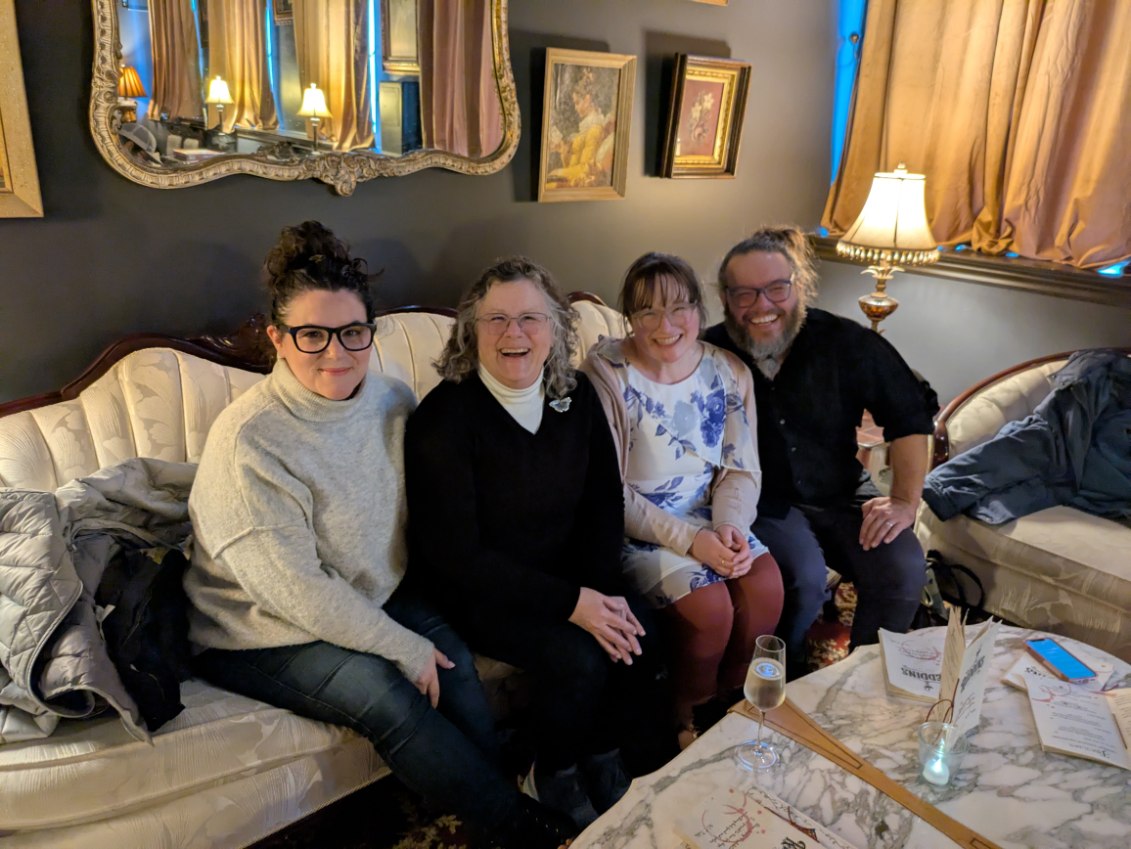
This past week was a beautiful juxtaposition for me. Maybe it was for you too? I had family in town, and I was so privileged to spend time with them, to go out to eat or for a drive and even to a speakeasy, and otherwise to run around playing tourist and share my beautiful local community with my mom and my sister.
Photo of my sister, my mom, myself and my husband seated on an antique couch at a local speakeasy, Reddins
At the same time that I got to spend time with them, I was aware of the devastating cuts that have passed the House and could potentially pass the Senate of the United States in the guise of a “big beautiful bill” that will actually take away the protections built into our constitution (in irrevocable ways) and steal essential resources, including environmental resources, from the poor and middle class to give tax breaks to the wealthy.
If I had allowed myself to focus on the potentially horrendous future ahead of us, I wouldn’t have been able to enjoy my time with my family. Thankfully, I’m well-practiced in mental fitness techniques, and even with the extra stressors that can pop up when interacting with family (due to old childhood patterns) or in being in new environments, I felt very equipped to enjoy my time with them.
So today, I thought I’d explore the saboteur that can often be at play when navigating these challenging times, as well as some ways to combat those thoughts and patterns as they arise, in hopes that it can help you too.
In the words of Positive Intelligence, “Saboteurs are deeply ingrained patterns of thinking and behavior that limit your potential and hinder your ability to perform at your best. They are internal critics that operate based on fear, self-doubt, and negative self-talk. Saboteur patterns can take various forms, such as the Avoider, the Hyper-Achiever, the Victim, and more. Each Saboteur has a unique way of sabotaging your wellbeing and success.”
Vigilance itself can be a very wise characteristic. Businesses, individuals, families, and other organizations benefit from people with the skill to be paying attention to future possibilities and preparing for them in a wise way.
But the Hyper-Vigilant Saboteur is perpetually alert, constantly scanning the horizon for any threats and anxious about what can go wrong. The Hyper-Vigilant Saboteur becomes chronically stressed, and by doubting yourself and other people, the saboteur makes sure that you aren’t able to be present, relax, or enjoy the present moment.
While these saboteurs originated as a way to protect us and keep us safe in childhood, when we overly rely on one type of behavior, it becomes disproportionate and gets in the way of our ability to enjoy life and to be efficient and effective. The Hyper-Vigilant Saboteur can look like the “boy who cried wolf”, getting anxious about EVERY possibility and potentially missing the true, actual dangers that deserve our focus and attention.
A 24/7 news cycle is built for those of us with a strong Hyper-Vigilant Saboteur. The news media focus on the negative and seize on our fear to keep us watching, reading, and tuning in. This makes us suspicious of other people and question our own safety and our own ability to weather the storm. You may feel skeptical or anxious or even constantly worrying thanks to this saboteur.
If you find your own anxious thoughts getting in the way of your ability to enjoy your present company, there are a few things you can do to help the situation:
When you catch the anxious thought patterns repeating themselves, stop and let those negative thoughts go. Recognizing that these are your saboteurs and your saboteurs’ limiting beliefs is the first step. (This is what we study and practice in my mental fitness programs.)
Take a ten second break to hyper-focus on your senses. This is mindfulness, but with extra focus. Feel the sensation of the wind in your hair or observe the inhale and exhale of your breath. Command your mind to be fully present on the colors or textures in front of you. (I teach some of these techniques when we complete a Saboteur Assessment. Consider joining me!)
Here are some other ideas for conquering your Hyper-Vigilant Saboteur:
Practice mindfulness – take a walk, meditate, do a body scan, mindfully enjoy a drink or a meal
Practice being present and discerning between true threats and the dangers you perceive. Take a breath and pause before deciding how to proceed in each situation
Find ways to challenge worst-case scenario thinking: consider alternatives, consider what’s likely,, or even follow your worst-case scenario thinking and then imagine how you’d handle it or how realistic that is
Ask a friend, or a coach, or a therapist for support and their perspective
Move from worrying and anxious thoughts to taking meaningful and specific actions
Though by adulthood, the neural pathways of our saboteurs are well-worn and well-honed, we can learn to create new neural pathways and build new habits using the wiser part of our mind. We are more than our saboteurs. And the more we do this work, the more joy we can find in the everyday moments, like a meal with those we love.
The world is so much right now. That in itself would be more than enough to deal with, don’t you think? But we’ve also got voices in our own heads. And those voices, though they originated from a helpful place, get in the way and stop us from tapping into the wisest parts of ourselves.
So today, using the language of Positive Intelligence, I’ll explore ten types of saboteurs that might be getting in the way of your life – and while there are MANY ways that we can counteract these habits and voices, I’ll suggest one.
Photo credit: Adorable donkey in a green field by Peter Jochim
Want a fuller understanding of how saboteurs are getting in the way of YOUR brain and YOUR life? Let’s set a time.
The Judge
The Judge is the universal saboteur. We’ve all got some level of judgment happening in our brain, whether it’s judging ourselves, judging other people, or judging the circumstances we are in.
Some of us have a perpetual inner critic that will never truly quiet down. For others, it comes and goes.
Dealing with anxiety, distress, or suffering? Feel guilt or shame? Do you struggle in relationships with other people? Chances are the judge is at the root of that.
The Judge will tell you it motivates you and you need it or you’ll get lazy and complacent. That’s a lie!
The Avoider
Do you find yourself focusing on the positive and avoiding potential conflict at all cost? The avoider wants to avoid difficult things, so the avoider will try to tell you everything’s great.
The lie of the avoider is that it says things will go away if you ignore them. Instead, they often will get bigger and blow up in your face.
The avoider suppresses any anger or resentment – another recipe for problems down the line.
When we deny conflicts or negative circumstances in front of us, the avoider is preventing us from actually doing something about them and making the situation better.
The Controller
The controller wants to deal with anxiety by controlling people and situations around them.
The controller is often a micromanager – incapable of seeing the bigger picture, which might tell us that it’s better to empower people or teach them to handle a situation themselves than always try to do it our way.
The controller gets temporary results, but at a major cost in our relationships and long-term ease, efficiency, and happiness.
The Hyper-Achiever
This common saboteur (especially seen in the corporate world) tells us we can relax, be happy, and stop working when we hit the next milestone. The hyper-achiever won’t let you celebrate for long, or relax, or enjoy the moment you’re in. It’s all about the achievements.
Your self-confidence and self-worth are, according to the hyper-achiever, defined by your achievements. But your wiser self knows you have inherent value, with or without achievements.
The hyper-achiever may avoid trying things unless they know they’ll be successful.
The Hyper-Rational
This saboteur focuses on the rational mind, to the exclusion of emotions, soft skills, and nuisance.
Those with a strong hyper-rational saboteur can be seen as cold, unthinking, and arrogant.
A refusal to acknowledge the role of people’s feelings and emotions can have a severe impact in relationships, whether at work or in your personal life.
The Hyper-Vigilant
Find yourself getting caught in worst-case-scenario thinking?
Are you anxious about the future and what could happen? Struggling to let go of your fears and be present?
The hyper-vigilant feels continuous and intense anxiety. This is exhausting and exhausts those around you too.
The Pleaser
The pleaser has learned to put the needs and desires of others first as a way of ensuring their own safety and survival. The pleaser believes this is how they will be loved.
The pleaser doesn’t express their own needs directly – everything is indirect. Meanwhile, they flatter and do for others. In an especially unhealthy place, this can come across as manipulation.
The pleaser can forget their own needs completely (emotional, physical, financial) which can lead to burnout and resentment. Others can also become dependent on them.
Restless
The restless saboteur is impatient. If they don’t see quick wins in a project or situation, rather than wait to see if it pans out later, they’re likely to try something out. This can lead to “shiny object” syndrome and keep them from pursuing and completing more complex projects.
The restless saboteur is always in search of excitement, experiencing FOMO, and easily distracted.
Underneath the surface, they’re escaping from the present to avoid dealing with hard things.
Stickler
The stickler is a perfectionist, and the stickler may struggle to accept the idea that “done is better than perfect”.
The stickler often holds themselves to higher standards than they do other people, though they may also hold others to those high standards.
They tend to have an inner compass telling them how to do things correctly – the problem is that we can’t do everything perfectly. It’s really only a small portion of things that NEED to be perfect.
They try to quiet the judgment of themselves and others through perfecting things.
Victim
The victim uses emotion to get attention and affection for themselves.
They tend to be dramatic and become depressed and fatigued due to what’s really repressed rage.
In their search for attention, it can backfire and actually push people away.
They may not feel seen or understood by others.
At the root of it all of our saboteurs, no matter what childhood experiences helped shape them and develop them, is fear. And while there are lots of saboteur-specific strategies that we can employ, the best way to face it all is to begin practicing non-judgmental self-awareness.
If we judge ourselves for when our saboteurs get a hold of us and we fall short of our highest goals, we are reinforcing the habits of our saboteurs – the habits we likely want to lean less heavily on, for our own health and happiness and to be more effective in our work.
Instead, try practicing non-judgmental self-awareness. If you notice your Victim or your Hyper-Achiever or your Judge, you can try laughing about it, or saying “hello there!” to your saboteurs. You can journal about it or just make a mental note. This practice is the first step to beginning to change our behavior.
Want some more guidance and more tools for conquering your own habits and saboteurs? I’d love to help.
In stressful situations, we tend to default to old habits and/or move into survival mode to keep ourselves safe. All of this is completely understandable.
Because we’ve all had different experiences, have different brains, differences, personalities and more, what one person does under stress can look quite different from someone else. It’s part of what makes us unique. But what isn’t unique is that we are all hardwired to do certain patterns of behavior under these circumstances.
In thinking about the state of the world right now, I’m especially aware of how dangerous traveling is for so many people right now. Perhaps you don’t feel safe traveling internationally (or at least, you don’t feel safe crossing the border to get back in). Perhaps you don’t feel safe going to the grocery store or even leaving your home.
The situations may be different, and the reasons may be different, but in any of these circumstances, the goal is for us to be able to stay calm under pressure. We want to know that we will be calm and in control of our actions, even if we are being interrogated or profiled or otherwise threatened.
So I want to talk a bit about what happens to us under pressure, and how we can strengthen our practices and our minds to help keep us safe (or at least increase the likelihood of a positive interaction) in future encounters.
Photo of blue sky and branches by Optical Chemist
I’m going to do so with compassion for others in challenging circumstances, to the best of my ability. I’m going to do so using the lens of the Enneagram and mental fitness. As usual, please keep in mind that I’m not a scientist or a therapist, and what I’m sharing are my own opinions based on my own experiences. If you want the technical scientific jargon, I probably won’t be going there, and I’m also not a lawyer or a therapist, so consult your own if possible and do your own homework and come to your own conclusions.
My personal belief is that we all have some sort of wise, wonderful being inside of us. Maybe you’d call it your soul, or your sage or your wise mind. This special being is there from the time we are born. As soon as we’re born, basically, we start having experiences in the real world. From the noises and feelings when we first leave the womb, to the ways our family of origin treats us, to the kind and the harsh and the horrible humans who cross our paths along the way, we are challenged.
As a result of these experiences, we start developing a personality. We pick up traits along the way. We find that we get positive reactions or are safer more frequently when we do certain things, so we lean into those more. In the language of Positive Intelligence, the mental fitness program I use in my training and coaching, we find that some of our skills and characteristics serve us well, so we do them more and more, eventually resulting in some “saboteur” behaviors. We might discover people-pleasing tendencies, or a hyper-achiever who tells us we must keep “doing” or we don’t have value. Maybe we develop restless or avoider or controlling saboteurs as ways of coping with the world.
In the language of the Enneagram, by the time we are adults, we’ve settled into a grab bag of personality traits that sometimes help us and sometimes hurt us, because we overly rely on them. They trap us. If we study the Enneagram, we’ll learn that there are other people in the world very similar to us, whose personality types are also aligned with ours, though our own individual circumstances and that underlying soul within us means we’re still all different people.
Whether we’re using the language of mental fitness or of the Enneagram, if we are privileged enough to begin working on ourselves, it begins with non-judgmental self-observation and a recognition that we’ve been holding so tightly to these personality traits and behaviors that they are no longer serving us. We recognize that if we want to become more of that beautiful soul, more of that lovely sage being, so wise and as we were created, we’ll need to let go of the grip that our personality holds on us.
And if we’re able to see this, whether it’s because we did a saboteur assessment or read a book or experienced a life-altering circumstance or something else entirely, then we’ll find ourselves asking the question: what’s next? How do I step out of these habitual patterns that I’ve been in for so long, that have me trapped in my own patterns of personality?
The answer, in a word? Presence.
When we are able to let go of the sabotaging thoughts and judgment of our own mind, and instead practice being in the present moment, it’s the first step toward our own self-actualization.
It sounds lofty, but if we are able to practice, day in and day out, being fully present where we are, whether that’s by getting outside in nature or fully savoring a meal or feeling the water on our hands, we are, step by step, loosening the grip of our personality and making it easier for the wisdom of our wise mind to make it to the surface.
You may be wondering what the heck this has to do with staying calm when we’re traveling. That’s fair!
But it has everything to do with it. If we practice grounding ourselves, using any tools of mindfulness, while letting go of judgment, we are increasing the likelihood that when we encounter a stressful situation, we will be able to hear the wisdom of our wise mind. We’ll increase the likelihood that we will know how to best take care of ourselves in that situation. We become calmer, and wiser, and less anxious. Our wise mind will recognize whether we need to go hide, or explore a solution, or fight back, or simply have the words to answer a question calmly and in the wisest way possible.
We don’t usually learn to do this work. We are rarely, if ever, taught these skills in school. We are not taught that our mental muscles need to be strengthened and exercised just as much as our physical muscles do.
If you’re curious about this, I’m pleased to offer a Saboteur Assessment, without cost, to anyone interested in learning more about how they’ve been getting in their own way. Whether or not you choose to work with me in the future, I’d love to help you gain the understanding to move forward in the world without being held back by your own patterns of personality.
I can’t control what happens to you when you travel. But I’d love to empower you with the tools to control as much as you CAN control in your life.
Hi folks. I hope this title spells out what this article will be. I’m going to specifically speak to those of you who are very concerned about what’s going on in the United States right now. In particular, I’ll spell out what’s making me most concerned. I’ll also share one way to help yourself to pay attention, but not too much attention, if you’re finding that looking at the news is really anxiety-provoking right now.
CW: I’m going to talk about some scary stuff that could happen very very soon. Especially to trans people.
Sound okay? Read on.
We as Americans are at an interesting time in our history. To say the least, right? Though I’ve been sounding the alarm for a long time, in the past week, I have gotten especially concerned that the combination of a government sending innocent people to prison and saying they can’t get them back, combined with talk of invalidating the passports/legal documentation of trans people entirely (as well as disenfranchisement for others, such as married women who changed their name at marriage but don’t have a matching birth certificate) is something we should find extremely frightening.
It’s such a tiny step to move from that to, oops, we are now sending trans people out of the country for the crime of being trans, and no, we can’t get them back. (And if the conditions are as awful as the 60 Minutes documentary exposes, how many people will die there? Even if it’s sometimes dying of lost hope?)
And after the trans folks are gone, what about the people of color? The liberals or the people who spoke against Trump? The intellectuals? The disabled? Queer people?
You get the idea.
If this stuff doesn’t scream Holocaust to you, then you don’t know your history.
And to be clear, I have trans friends, family members, work colleagues etc. Tons of people that I know and love and respect. I am so angry right now.
Many people I’ve been talking to have said they’re getting anxious, or even having a panic attack, when they look at the news headlines. I hear you, and it’s so hard right now.
My personal suggestions if you’re struggling in this way?
Limit yourself to a very short window where you check in on the headlines every day. If that proves too much, go to a trusted friend or family member for a daily summary of what you need to know, AKA what should I call my reps about today, or what should I make sure I do? If you can’t do it daily, do it weekly or as often as you can.
Before you check the headlines, take some time to meditate/practice some form of mindfulness. Savor the feeling of hot water on your back as you shower. Enjoy some tea or coffee and really savor it. Get outside for a walk in nature. Focus on the detailed sensations where you are. Then, and only then, when you’re in a good space, read the headlines. Set an alarm and then do some more self-care. Repeat as needed.
If your current source of news is “too real”, change it up. Skip the TV and read an article. Move to a weekly instead of a daily cadence if daily is too much. Read a blogger you respect instead of a Facebook feed.
These are the ways I am making it work for me right now, and I hope some combination of these things might work for you too.
And while I am 100% not a lawyer, not an expert etc., I will say that if you have some privileges right now, now is truly the time to use them. Things have gone south so quickly, and there’s not much progress happening. What does that translate to?
Keep boycotting if you can. Keep protesting if you can. Keep calling. And keep making noise. We are going to need as many people as possible to keep resisting.
And if you’re in a role where you are being asked to do something that you know is immoral by our federal government or by your organization, consider the consequences of saying no, or of quietly ignoring the order.
And if you’re trans? I am frightened for you. I know everyone’s circumstances vary, but if you can get to Canada or another country and ask for asylum, maybe it’s time to consider it? If I had the money and I were trans, I’d be gone. On the other hand, I know traveling at all right now could increase your visibility which may not be helpfull. So maybe talk to a lawyer. If you have these privileges, of course. Because of the ways we’ve treated you, you’re less likely to have the cash for such moves. I am so sorry, and I won’t stop fighting. But we are in the danger zone, friends, so while it’s only a small minority of you who may have these kinds of financial privileges and options, I don’t think there’s any shame in taking care of yourself if that’s available to you. (And for all of us, organizations like the Transgender Law Center would love your support.)
If you’re white and/or privileged, consider if there’s a bigger role you could play right now. Can you take a stand at work when they’re axing DEI programs to remain compliant with the government? Can you speak up to ICE or the police or elected officials when you see something wrong happening in front of you? Can you stage something larger, or fight back in a more prominent way? I remember how much I was in awe of Julia Butterfly Hill, living for 738 days as an act of civil disobedience in a redwood tree. Do you have a way to use your power and visibility to support the people and causes you care about?
I’d love to hear your thoughts on all of this. What are you doing? I know it’s awful, and I wish I could fix it. I’ll keep working to do whatever I can. And mental fitness will be playing a very important role in that.
In the world we’re living in, with politics and climate change and humanitarian crises filling our brains and our neighborhoods and our news feeds, I could not be more grateful to be nearly three years into my mental fitness training. What began as a curiosity after six months of intense work to reign in my growing anxiety turned out to be the missing tool in my client work and in my own mental health, and I couldn’t be more thankful for it – especially right now. Today I’d like to share how I found mental fitness and the difference it’s made in my life.
Photo of a person with a cloth headband and simple dress with their back turned to the camera, looking out at a beautiful nature scene by Anastasia Shuraeva
Until my mid-thirties, I didn’t believe I suffered from anxiety. While I was diagnosed with and treated for “depression” as a busy early teen who’d started falling asleep in her classes and after school (in part due to the side effects from my allergy medication), I did talk therapy for a year and was told I was fine, basically, and the sessions stopped, because I was no longer falling asleep all the time and seemed functional and able to handle my activities again.
My life up until that point involved a major identification with the word “busy”. When asked how I was doing, I said I was busy. I was in multiple theater productions (my record was three at a time), taking piano lessons, starting clubs and singing in choirs. I stopped dance lessons mid-way through eighth grade as my theater passion took over (and I’d recently given up dance competitions, which is another article unto itself), but I had added voice lessons into the mix by high school and was also required to participate in three sports or athletic programs each year at the private day school I attended.
So yes. I was busy. And this identification with the word “busy” continued through high school, into college, and into my twenties, where any feelings I had of overwhelm or extra adrenaline or a racing heart etc. were labeled as “busy” at best and otherwise ignored. And when my body started showing signs of chronic health conditions, I pursued diagnoses for physical conditions without recognizing that there might be mental conditions worth exploring too.
It wasn’t until I figured out how to support my husband’s dream (traveling as a touring musician) by having the two of us buy a used RV and travel the United States that things started to shift. I relied on adrenaline and discipline and problem-solving to get through the transition, even in the face of my newer symptoms of fatigue, but by the time we’d been on the road for six months or so, things began to shift. Without a theater company to run, with minimal lessons to teach and nowhere to physically be (unless we wanted to), my mind began to open up, and I found myself asking questions I hadn’t really delved into deeply and from a wise state of mind before.
The questions looked something like these:
Why have I been so successful as a creative, and yet I’ve never earned more than $50,000 in a year?
What are my beliefs around money? Around success?
Where do I want to be in ten years? In twenty?
Who am I if I’m living a simpler life?
What does community mean to me?
Who are really my friends? Who are the friends who believe in me, even when I don’t have anything to offer them but my friendship?
As I began pursuing personal development for the first time, through programs and books and podcasts and an accountability group, I also was living with my husband in very close quarters on a daily basis for the first time. As he worked through his own mental health challenges, I started to see signs that I may also be living with anxiety for the first time. I began occasionally getting panic attacks – and they’d be triggered by my husband’s own struggles to regulate. I began to see with clarity my own signs of codependency and my struggles to maintain boundaries and protect myself from taking on other people’s emotions.
In the midst of these studies, COVID hit, and as Ross and I were prepping for a move to Canada in light of the uncertain political situation and fears that we wouldn’t be able to maintain a unique lifestyle that we loved if we lost our rights to affordable health care and control of our own bodies, we learned to work through new fears and anxieties for the future.
My body and mind were incredible to me during this time. I was working more hours than ever in my online businesses at the same time that I was overseeing a move to Canada, which felt like a fulltime job in itself.
Is it any wonder that by the time we got settled into our new Canada apartment, maybe two months in, my anxiety kicked into overdrive?
I finally felt safe, settled, and like I could relax. We’d gotten what we’d worked so hard for. We’d even crossed the border when such travel was still very restricted, especially on Prince Edward Island. And with this sense of safety and calm, my body said, ‘FINALLY!”. My anxiety rose to the top and spilled out all over the place. It was something like the way athletes get sick after the big competition or students and teachers get sick on vacation.
I was having several anxiety attacks a week. Driving became especially triggering. It was when I noticed it was starting to get in the way of my work that I sought professional help. I went to a mental health clinic and got on the list to see a psychologist. I signed up for Betterhelp to have a more affordable option than the going rate, and I went through one mediocre therapist on that platform before finding someone who had a lot to offer me. After several months on the wait list, I saw an in-person psychologist on PEI’s dime, who unfortunately didn’t seem capable of helping someone as high-performing as me. (She didn’t know what to do with me. Sound familiar to anyone else?) I completed a local anti-anxiety program called ICAN, which gave me excellent practice with anti-anxiety tools like body scans, 5 4 3 2 1, breaking anxiety-producing tasks into smaller pieces and many more.
In other words, I had a ton of support, which I’m grateful for. And I am sure it all helped, especially the anti-anxiety program, to get me through the worst of it. As I did the work, I started to observe myself going weeks and eventually even months between panic attacks.
And then, thanks to a fellow life coach, I discovered Positive Intelligence.
I took advantage of a free program for active coaches. Seven or so weeks of training in mental fitness, led by coach Shirzad Chamine and based on the most cutting edge science and research. We were required to maintain an accountability group and do daily check-ins with each other as part of the process, in addition to weekly group meetings over Zoom.
I entered the program skeptical that anything free could be that transformative. But I was soon a convert. My husband noticed differences in me too. When it ended, I knew I was signing up for further study and to begin training so I could bring mental fitness into my coaching practice.
There’s a lot about Positive Intelligence that resembles the personality study I’d been doing using the Enneagram since 2019. But there are a lot of distinctions too. While my Enneagram work had shown a brilliant light on where I was trapped in patterns of behavior, I hadn’t made significant progress in improving that behavior and growing toward a healthier way of being. (I had, however, developed a lot of compassion and understanding of how to be in better relationship with my family and friends and my husband – some major wins!)
With my new mental fitness tools and a daily commitment to practicing them (thanks in part to the genius Positive Intelligence app included in my study), things started to improve for me really quickly.
I became calmer in the face of stress. I became less likely to get triggered by my husband or a family member or a member of my chorus. I became better able to tap into a wiser, bird’s eye view perspective of my life. I became happier, more easygoing, and a more effective coach, partner, friend and family member.
And over and over again, my clients who chose to study mental fitness with me also were reaping the benefits. They became less reactive, more able to handle grief, better able to get things done (from creating and living by a budget to making phone calls or regulating their own anger and anxiety).
For me, and for so many in my work, mental fitness has been the missing piece. Instead of continually watching themselves repeating patterns but struggling to break free of them, they were able to be more effective and efficient, spending more time in that wiser part of their brain and quieting the negative and sabotaging parts of it. They were happier. And they got to benefit from a more healthy and regulated coach better able to guide them.
With hindsight, I can see that the big piece missing in my own Enneagram studies in the first several years was a commitment to a contemplative practice. At most, I’d dabbled in meditation, and while I went through periods where I got out in nature daily while we were RVing (often for hours at a time), I didn’t recognize it for the meditation that it was, or that it could have been, if I’d taken the podcast out of my ears and really tuned in to my surroundings. Until I joined Enneagram trainings and workshops (rather than simply reading books or listening to podcasts), I wasn’t clear on how essential it is to pair Enneagram work with meditation and other tools. By the time I began doing that that, thankfully, I’d incorporated Positive Intelligence into my life. All of sudden, I was growing mental muscles. My mental fitness and Enneagram work began to support each other.
I remember a few years back, sharing with delight an incident from earlier in the week with my first Enneagram cohort.
At the time, I had a plastic bin next to my bed, and on it, I had a humidifier. I also had a variety of different possessions, including a book, as I was using the bin as a night stand. On this particular evening, I’d fallen asleep and reached over to grab something, and I hit water. Everywhere. Everything on the stand was soaked.
Prior to my Enneagram or mental fitness studies, I would have been hit with a wave of self-revulsion for having made this mistake. My inner critic would have kicked into high gear. And then I would have been angry, jumping into action without stopping to think and cleaning all of it up myself. If at some point down the line I had thought to ask my husband (who was still wide awake) for help, I would have done so in an angry, frustrated state. When met with that heightened, angry and panicked state, my husband would have responded with his own saboteurs, and I know from past experiences this would have led to us both triggering each other and lengthening the process until we could each calm down, forgive as needed, and come to bed and fall asleep.
Instead, I felt the water, realized I was very close to sleep and didn’t want to wake up and ruin that, so I called out to my husband.
“Ross, can you help me with something?” I calmly asked. He came in, happy to assist, be helpful, and answer my calm request. I explained the situation and asked if he could help me since I was almost asleep. He agreed. Given that he struggles in those moments to know what to do, I then began making requests. “Can you go get a towel please?” “Can you put this over there?” I talked him through it, but did so calmly, lying in bed, and trusting him to figure out details of where to hang towels or set items to try.
And when all that was done, I simply rolled over and went back to sleep.
Nowadays, even in the face of this wild rollercoaster of a world, I am extremely grateful. For calm. For days where I am seldom, if ever, thrown off. Even in the face of hard things, it’s the rare day when I have to work hard to stay regulated. I’m able to preemptively do my mental fitness exercises long before a panic attack. And I am healthier, kinder, and more whole in my responses to the world.
Do you have a mental fitness practice? Want to learn more about the saboteurs that are keeping you from living your best life, day in and day out? Imagine what’s possible for you in your relationships, your career, and across your life with this change! It’s never too late to find more joy in your life.
This week in my inbox, Ruth Schalkhauser Tower of Inner Sky Living shared a reflection on leaving room for alternate positive realities. She reflected on how much energy she and her family put into negotiating a change in situation for her mom, only to find out, after much worry and planning on their part about how she’d take it, that mom was already thrilled about the upcoming change in circumstance.
Can you relate to that? Have you ever started making phone calls or gone on an endless anxiety loop, forecasting potential outcomes from something you are really upset about, only for it to turn out to not really be a big deal at all? Or, in fact, maybe it ended up being the best thing that ever happened to you!
Maybe it was a job you didn’t get, or a job you lost.
Maybe it was the relationship you tried so hard to save, but it was that relationship ending that led you to your current partner, or a career change, or to meeting your best friend.
Maybe not being able to come up with the money to buy the house or start the business or go to the school ended up being a gift in disguise.
I love this concept, and particularly her phrase of “alternate positive realities”. It reminds me of a term we use frequently in my mental fitness work: the sage perspective.
The sage perspective, in essence, says “who knows what is good, or what is bad?” The sage perspective says that if we are open to it, we may actually find that something we perceive as a negative now could be a net positive for us, or it could at least have positives in addition to the negatives. It doesn’t deny the negative consequences of what happened, but it asks us to consider the possibility that there may be positives from it that we may not see yet.
One way that I find makes it easier, at least when I’ve done my mindfulness exercises and gotten myself into my sage, wise part of my mind, to deal with fear and anger and sadness and discomfort from news headlines or other life stuff is to remember that I can hold space for the positive possibilities.
Perhaps this awful thing will cause people to see so-and-so for who they truly are.
Perhaps this will inspire bigger and bolder action that is transformative, positively, in the long run.
Similarly, perhaps this stressful or challenging task I have to do is preparing me to be more resilient and better able to handle future challenges down the line.
When we create space for positive possibilities, we don’t erase hurtful or problematic or even evil behaviors. But we can create space for finding the good. As Mr. Rogers used to say, we can look for the helpers.
P.S. Want to learn more about the sage perspective? Book your saboteur assessment feedback session here.
Photo of an elderly man staring at the sea through bars by Muhahmadhu Areesh
A recent conversation with a friend made me realize it’s time for me to tackle the biggest announcement I’ve made in my business in a long time. Read on for a little context, history, and some vulnerability about where I am and where I’m headed.
When I began working with my first coaching client at the beginning of 2020, I couldn’t have told you what my niche was or who my ideal coaching client was. I knew all of those answers for my virtual assistant (VA) business, of course, since that business had been going strong for a couple of years. But I think it’s fairly common to begin a business like coaching or freelancing or working as a VA and to not actually know, or at least not articulate, who your ideal client is. (And the truth is that sometimes, for some of us we actually have MULTIPLE ideal clients – and while that’s hard to manage as a business owner, it’s the truth for some of us multi-passionate folks!)
This uncertainty or lack of clarity in our marketing tends to happen for two reasons – we’re either living in a scarcity mindset, feeling we need to take every potential offer that comes our way if we want to survive in this business, or we honestly just haven’t done enough work in our chosen field to have made a decision about who we serve best and who we actually want to serve in our work. (And quite often, both of those things are true, to one degree or another!)
But if you know anything about marketing or have ever started your own business or project, you’re probably familiar with the compelling reasons to consider clearly defining your niche. As I began adding mental fitness training and Enneagram work into my business, I had multiple coaches encouraging me to get more specific with my niche so that other people knew who to refer to me and so that I could be a more unique presence, and even a thought leader in the world.
As I looked back at the clients I’d had to date, I started to realize there were a few patterns in who I tended to work with:
Women in their late twenties to early fifties (with exceptions occasionally on either end, and the occasional compassionate man or non-binary client in the mix)
People with a creative interest, hobby, or business that they’re passionate about
Neurodivergence is common (ADHD, highly sensitive, autistic etc.) though they often weren’t aware until adulthood
Spiritual or spiritually curious in some way (nearly always)
Childfree (meaning they don’t have any children)
The truth is, we get to decide who we want to work with! And it’s never too late to reinvent ourselves. But when I looked at who I’d attracted as clients to date, ALL of them people I’d really enjoyed working with, I realized that there was wisdom to be had there. And while I am truly open to working with ANY client who resonates with who I am, what I believe in, and what I am called to offer the world, I realized that one of my most particular gifts (and privileges) stems from the fact that I am childfree.
When I use the word childfree, it means someone doesn’t have any children. For me, and for many of us in the world, it’s a great neutral term for people who don’t have any children. Just like dairy-free means without dairy, I don’t have any kids.
There are many ways people self-identify. I don’t choose the word childless, because in my experience, I associate that word with those who, for one reason or another, were not or are not able to have children. While I have a lot in common with those people, given my lifestyle, I am personally “childfree by choice”, meaning I’ve had the privilege of choosing a life that does not involve having or raising a child.
So in the category of childfree, I’d personally include both “childless” people as well as “childfree by choice” people. We all have a lot in common, because we’re able to plan our schedules and set our goals without needing to consider any of the complex needs of children in the equation. We may also have other experiences and concerns in common, like worrying about who will care for us as we age, for instance.
So while I don’t personally know the pain of a person who desperately wanted to have children and couldn’t, I have a lot in common with them, and I am able to bond with them and other childfree women in a lot of areas.
What’s controversial about the word childfree? Well, some people have a hard time when I talk about being childfree. Heck, some people have a hard time when anyone talks about being childfree. Just as people get up in arms about critical race theory or or drag story hour, there are a lot of parents and people more generally who take offense when people talk about their childfree life.
Just a quick scroll through social media shows me gems like this:
“So sad when a woman doesn’t have children to call her own. Lonely life.”
The truth is that our society (and most of them around the world) is built on the assumption that we will be parents, and we will raise children. (Incidentally, it also tells us children will fulfill us and make us happy – and that is just as flawed an assumption!) And because we’re not taught to discern the thoughts we’ve internalized and made autopilot that we’ve inherited from our caregivers and society, many of us don’t even question the assumptions that we’ll have children until we’ve already had them – wild to think about, isn’t it?
Learning to question the assumptions our society makes and that we’ve probably inherited about child rearing is one of the steps toward becoming a wiser, more nuanced, more thoughtful version of ourselves. As we do the work to learn to pause and reflect before doing or saying or getting caught in a thought/panic/emotional spiral because of a particular trigger, we learn to live less from our personality, which is made up of the layers of ways we’ve learned to interact with the world, and more from our sage, wise, internal knowing – that being we’ve been ever since we were born, and that intuitive, creative, intelligent soul that we tap into when we’re meditating or otherwise in a state of “flow”.
I’m childfree. I coach childfree women. I also coach people with grown children, and people with children. But since most of the people who are drawn to my work and who reach out to me are childfree, I’m not going to shy away from sharing that part of my life with you. After all, being a traveler and adventurer, creating a life I love, and helping others to do the same, has been a much easier and natural road for me because I am childfree.
If you’re going through a transition, struggling to overcome anxiety or overwhelm, feeling like you “should” be happier but aren’t, or are ready for the next step in life and wanting some help to get clear on your next life or career choices, I’d be honored to speak with you. Even if you don’t have a clue what you’re looking for but this resonates, let’s talk.
And if you know someone, perhaps someone childfree or whose kids have left home, who might enjoy reading this or speaking with me, I’d be honored if you’d connect me with them.
Just grab a spot on my calendar if you’d like a gift from me – an hour of my time where I can help you to gain clarity on what’s next. Zero cost or obligation. Thank you for reading. Let’s connect.
P.S. If you’re childfree, I’d love to hear what resonates from this message. And if you’re not, do you have any more questions for me? Don’t hesitate to share them too.
This is the time of year when I take time to reflect.
Where was I at this time last year, and how much progress did I make?
What moved the needle for me?
Am I satisfied with my progress?
Am I proud of what I did, in spite of all of the challenges and pressures?
Ultimately, this reflection needs to be in balance. Shaming ourselves for what we didn’t accomplish or beating ourselves up isn’t the answer.
Likewise, brushing past our shortcomings and forgetting the ways we let ourselves down entirely risks us repeating mistakes again.
There is a gift in everything that happens to us, if we choose to see it. There is a gift in every choice we made, whatever the outcome, if we are lucky enough to make it through.
The key, though, is deciding there’s a gift, and then finding what it is.
And showing ourselves, and those around us, empathy is an essential part of the process.
I do this reflection work in several ways; on my own, in my mastermind, with close friends, and sometimes with a coach, like I did yesterday.
I will do similar work as I set goals and plan how I will hold myself accountable and set up great habits in 2023.
Today I celebrate me:
I am a childfree coach supporting women and all who are ready to create a life they love
I have made incredible strides in my mental fitness
I have made professional gains in the arts and in my writing (and a bit in my speaking career too)
I have gained a lot of clarity in my business
I have shown love, and compassion, and supported many dozens of people this year, not least of all my family
I’ve helped my clients improve their lives and find more joy and success
I’ve started three new group programs
I have had so much fun
I have made new friends, strengthened existing friendships, and further contributed to and built community around me
I wish you joy and peace in this holiday season, whatever you celebrate (or don’t).
P.S. I do have at least one more spot in my mental fitness program for January. If you’d like an affordable route to accountability, peace, success, and even community, you can grab a spot on my calendar to learn more. Please book ASAP as I am taking some time off for the holidays and the group program starts the second week of January. Feel free to email rossandjamieadventure @ gmail.com if you don’t see a time that works for you.
P.P.S. What is the one thing you are celebrating yourself for as we close out 2022?
I keep changing and changing and changing this title, but in truth, I know exactly what I’m going to say. The conundrum, of course, is that while I have learned that anxiety, even lifelong, chronic anxiety struggles, can get better, I also don’t want to be one of those people promising you snake oil or making you feel invisible if your anxiety proves to be way more stubborn than my own challenges have been.
So, with that caveat, here’s an update on where I’m at, how I did it, and what I can suggest for other people who are struggling too.
The Recap
Last October, I started having panic attacks. Debilitating ones, that were really getting in the way of my work and my life. While I had experienced perhaps a half dozen panic attacks while living in an RV and traveling the US, I was otherwise completely new to them. And when I’d had them, they hadn’t gotten in the way of my work or my life – I knew what triggered them, and within a few hours, I’d been able to move on from them.
But last fall was different. My husband was really worried. I was really worried too; as the current primary breadwinner in our relationship, and with a husband who was a full-time student, what if I couldn’t pay our bills? So I was having panic attacks and I was spiraling further, getting anxious about having anxiety, which I’ve since read is a sign of an anxiety disorder rather than simply anxiety (which everyone has on some level, and which is 100% normal, to my totally not clinical but still very educated on anxiety understanding).
On one particularly bad day, after a series of particularly bad days, I wanted to go to the mental health clinic. But, of course, I was anxious to go. I didn’t know what to expect. I didn’t quite believe they’d let me in, especially because I hadn’t received my health card yet (which is your ticket to free health care as a Canadian resident).
My loving husband took me. He sat with me patiently in the car, and he came inside with me too. And the therapist I saw was so affirming, so understanding, and so encouraging as she got me on the list for free province-provided therapy. She even believed me and took notes when I told her I’d recently realized the ample supplies of nightshade vegetables I’d been filling my diet with were apparently a huge anxiety trigger (tomatoes, peppers, potatoes, and eggplant were filling my diet during this harvest season), based on my own Googled research.
This began more than six months of challenges as I waited, and waited, and waited to get that free therapy. Backing off the nightshade vegetables helped make the panic attacks less frequent (think 1-2 per week rather than daily), and I finally signed up online with my first therapist since college. She went from being okay for a few months, helping me to treat the anxiety, to being completely awful, around the same time I was seeing a very mediocre (at least for me) free therapist (finally) provided by the province.
Things Began Shifting
By the spring, a few things began shifting in my life:
I wrapped a contract with a client that had been having a negative effect on my mental health for a very long time, giving me space to begin healing from what I later realized was pretty intense burnout
The work I’d been doing on myself using the Enneagram was paying off, and I was seeing the benefits in my relationship with Ross, with my family and friends, and most importantly in my relationship with myself too
I found a new therapist who was NIGHT AND DAY from my previous experiences; she’s still supporting me, and I am grateful every day that I didn’t give up on finding the right person for me
The time I’d invested in finding community on PEI was bearing fruit; I had local friends and was doing meaningful work, collaborating in multiple music ensembles and enjoying the opportunity to lead one of them
I created an Enneagram group and had a really successful pilot program (my first group coaching program over several months)
I discovered the Positive Intelligence framework and became a major advocate for the benefits of mental fitness (and subsequently, I became a mental fitness trainer and incorporated the work into my coaching business)
I finally stepped outside of my comfort zone into an Anti-Anxiety program offered free to Islanders (called I CAN) and completed it successfully
According to my anxiety coach, my last panic attack was in late August. I know it was a combination of the techniques I had internalized by this point (learned in both I CAN and in my mental fitness studies) as well as some of the deeper personal development I had done. Having my therapist to cheer me on was especially helpful on the days I needed someone to vent to – whether you work with a therapist as well (always ideal) or just find a friend or hire a coach or accountability partner, that safe space was key.
I’ve now realized that I’ve been battling anxiety my entire life, or at least as far back as middle school. I also realize that if I had known then what I know now about mental fitness, I wouldn’t have needed to have the stress and overwhelm in my life. And I would have made healthier choices from a sage place rather than acting out of fear or to numb or distract myself.
What I Recommend
My own personal journey to get control of my anxiety was more long-winded than it needed to be, but there were also a lot of factors at stake. If I hadn’t been overwhelmed in my work, things might have played out differently, perhaps on a faster timetable. If I wasn’t so sensitive to nightshades, the panic attacks may have been less debilitating. But what I now realize is that the gift of my panic and anxiety struggles over the past year or more is that I now have direct experience I can use when coaching my clients. I can relate to them in ways I never could have five years back. What a gift!
Also, for those of you with access to some kind of free anxiety program, or one that’s very affordable for you, do consider it, if you’ve got the bandwidth for it. While I wasn’t learning many new things in mine, the daily practice and accountability (just like I use with my clients) helped me to finally finish integrating all the things people had taught me over the years. I CAN is a great option for Islanders. Find out what, if anything, is available for you.
If you want to sleep well at night, if you want a life with less stress and overwhelm, if you want the tools to find joy and peace and curiosity again, I’d love to introduce you to the mental fitness training we can do together. I have a few spots open in a small group program that will be starting up this January. I’m also developing a new program specifically with musicians in mind, and I’m planning future groups for a) for childfree people b) for men and c) for retirees.
If you’re intrigued, the easiest way for me to tell you more is for us to hop on a call so I can give you a tour of the program and a bit of coaching and some training to incorporate when you’re feeling anxious or fearful or angry or judgmental. I include a few of my favorite mindfulness techniques that you can actually use anywhere, at any time. It’s a free call, and if it intrigues you, I’m offering my programs on a sliding scale to make them as accessible as possible as we begin 2023.
I have such gratitude to be a coach and to be doing this life-changing work. Please reach out to learn more, and if you think this might resonate with a friend or a family member, please encourage them to do the same.