This week in my inbox, Ruth Schalkhauser Tower of Inner Sky Living shared a reflection on leaving room for alternate positive realities. She reflected on how much energy she and her family put into negotiating a change in situation for her mom, only to find out, after much worry and planning on their part about how she’d take it, that mom was already thrilled about the upcoming change in circumstance.
Can you relate to that? Have you ever started making phone calls or gone on an endless anxiety loop, forecasting potential outcomes from something you are really upset about, only for it to turn out to not really be a big deal at all? Or, in fact, maybe it ended up being the best thing that ever happened to you!
Maybe it was a job you didn’t get, or a job you lost.
Maybe it was the relationship you tried so hard to save, but it was that relationship ending that led you to your current partner, or a career change, or to meeting your best friend.
Maybe not being able to come up with the money to buy the house or start the business or go to the school ended up being a gift in disguise.
I love this concept, and particularly her phrase of “alternate positive realities”. It reminds me of a term we use frequently in my mental fitness work: the sage perspective.
The sage perspective, in essence, says “who knows what is good, or what is bad?” The sage perspective says that if we are open to it, we may actually find that something we perceive as a negative now could be a net positive for us, or it could at least have positives in addition to the negatives. It doesn’t deny the negative consequences of what happened, but it asks us to consider the possibility that there may be positives from it that we may not see yet.
One way that I find makes it easier, at least when I’ve done my mindfulness exercises and gotten myself into my sage, wise part of my mind, to deal with fear and anger and sadness and discomfort from news headlines or other life stuff is to remember that I can hold space for the positive possibilities.
Perhaps this awful thing will cause people to see so-and-so for who they truly are.
Perhaps this will inspire bigger and bolder action that is transformative, positively, in the long run.
Similarly, perhaps this stressful or challenging task I have to do is preparing me to be more resilient and better able to handle future challenges down the line.
When we create space for positive possibilities, we don’t erase hurtful or problematic or even evil behaviors. But we can create space for finding the good. As Mr. Rogers used to say, we can look for the helpers.
P.S. Want to learn more about the sage perspective? Book your saboteur assessment feedback session here.
Photo of an elderly man staring at the sea through bars by Muhahmadhu Areesh
TW: for a frank conversation around my own struggles with food and references to diet culture
I’ve been studying the Enneagram for more than five years, and because of that, most of what I’ve studied feels quite ingrained and accessible. But with anything we learn, I think, there are layers, and as we go through new situations in our life and move further along our path (hopefully toward self-actualization), life has a tendency to throw us the same types of situations again and again, in hopes, perhaps, that we’re ready for a new lesson and can grow further as a result. A mentor of mine recently described this idea as a spiral path for growth, and I know that isn’t a new concept for many of us.
My relationship with food, of course, goes back much farther than my relationship with the Enneagram. My own relationship with food is complicated, with past experiences and challenges around food security, trust, and control. Add to that a hefty dose of diet culture in the 80s and 90s and throw in the fact that in the past eight years, I’ve realized I can’t eat gluten and have some other food sensitivities, and you’ve truly got a recipe for food issues, to say the least.
I could share a number of stories about the effects this has had on my life, and about how many therapy and journaling sessions I’ve devoted to it, but I had a particular experience this week that I found absolutely fascinating and couldn’t resist sharing.
Last night, while talking to Ross (my husband), I said I wanted to open the mint chip ice cream we had in the freezer and have some for dessert. He was supportive, of course. I’d purchased it on sale (it’s my favorite Chapman’s flavor) and I was looking forward to it.
Perhaps a half hour after we chatted, I realized I hadn’t yet gotten up from the table to get myself some ice cream. I washed my hands, grabbed a bowl and spoon, removed the ice cream from the freezer, removed the layer of plastic wrapped around the carton, and began scooping myself ice cream. The bowl isn’t especially large, as it fits in the palm of my hand, but it easily fits a lot of ice cream in it. I remember scooping some, and then more, and then more so it went over the top of the bowl, and then filling in some of the gaps, and then I’m sure I had my inner critic chime in that it was plenty and I’d want some later so leave some for the rest of the week. I put away the carton and grabbed my bowl and spoon.
It wasn’t until I set the ice cream down on the table that I looked at it and thought to myself, why is there so much ice cream in my bowl?
Common reasons I might have told myself I was having a large portion of ice cream in the past have included:
I’m really hungry
I’m having one of those days where nothing satiates me…ice cream will
I need more protein today (yes, that’s a real reason I’ve given myself)
I don’t want to leave a little bit in the carton
It’s a special celebration day
I’m at an ice cream place I won’t be back to for a while (or ever), so enjoy it now
This ice cream place is seasonal and closing soon – make the most of it
I’m having a tough day. Ice cream will make me feel better
I’m sure there are others as well. But do you know what I realized last night?
I hadn’t had ANY of those thoughts. Because I actually hadn’t stopped to think. At ALL. I’d had the gut impulse/light bulb moment/memory of my conversation with Ross which then sent me into the kitchen to get myself ice cream.
And then I brought it to the table. Then, and only then, did I look at how much ice cream I’d given myself and think, hmm, I’m not especially hungry. I’ve got some healthier habits I’m working on. I would have even been happier with a smaller bowl. Why in the world did I give myself so much ice cream?
And the answer, clear as day, that came to me, was because I hadn’t stopped to think.
At all.
So, if that isn’t making sense to you, congratulations! You’re probably not an 8, 9, or 1 on the Enneagram. You may not be a dependent number (a 1, 2, or 6) either.
These three numbers, 8/9/1, are in the “gut” or “anger” or “rage” triad. Part of what makes us unique is that we are dominant “doers”. We all rely heavily on “doing” as we go about our day, with different flavors for each number. As a 1, I’m predominantly “doing” when I am in my automatic, auto-pilot part of my being (which is most of the time, for most of us), with this doing fed by how I am feeling about things, though I may not be self-aware enough to be able to articulate the feeling underneath it. When stressful things happen and I feel things, I react to my feelings by doing. But the main thing here, when we’re in this triad, is that we are doers. We are “doing dominant”.
(Side note – 8s are doing dominant, supported by thinking, and 9s would be both doing dominant and doing repressed, but that’s a story for another day.)
Now, this isn’t a bad thing about myself; it just is. But the other piece of this puzzle is that as a member of the dependent stance (made up of 1s, 2s, and 6s), I am by definition thinking repressed. This means that I am less likely to do productive thinking than the members of the other two stances.
Members of the dependent stance are certainly thinking a lot, perhaps even more than others, but that doesn’t mean our thinking is necessarily productive. We are defined by the fact that it is a big challenge for us to bring up productive thinking, at least if we haven’t done a LOT of work.
So, as a person who thinks of herself (and is thought of by others) as a pretty smart person, I’ve had to wrestle a lot with how repressed thinking shows up for me.
And last night, my goodness. Is that not a perfect example of it?
There were so many times along the path from refrigerator to table where I could have stopped to think: Do I want a small amount of ice cream, or a large one? How hungry am I right now? I’ve got some health goals for the future – should I consider those right now? Am I having a strong craving? How would I feel if I didn’t eat ice cream tonight?
My friends, I thought none of those things. I simply got myself a big bowl of ice cream.
And honestly, if I hadn’t done a lot of work on myself, between studying the Enneagram and mental fitness (which has been my best tool for slowing down these auto-pilot moments), I don’t think I would have even noticed.
(This is also, more generally, a perfect example of the kind of automatic responses and habits built into our personality that require a practice of non-judgmental self-observation to be able to recognize it and potentially make another choice. The Enneagram and mental fitness are both beautiful tools for this.)
Of course, as soon as I observed myself at the table, it got me thinking. What factor has this behavior played when I’ve worked on losing weight? What factor has this played in changing my habits to healthier ones? If I could gain more awareness in this moment, perhaps even long enough to do a short mindfulness exercise, could I eat less each night? How would that feel?
I’ve let go of wanting to be a particular size, for the most part. My only holdout is a couple of beautiful dresses I will likely never be able to wear again. But I think I’m going to be okay with that. However, I want my future self to be as fit as I am currently. And I’ve realized recently, in part influenced by the book Outlive, that if I want to be this fit at 60, or at 80, I need to become super-fit NOW. Because our bodies have a tendency to lose muscle, and lose strength, lose stability as we age, the only way to set myself up for a healthy retirement is actually to get MORE fit than I would otherwise care to right now.
Obviously, to even think about doing that requires some privileges, and I’m not fully convinced if this is even a realistic goal for me in my life right now. But I do have it in the back of my mind as I explore steps I can take, and habits I can form, moving in that direction.
And I guess what I’m saying is, we talk about mindless eating. I don’t do that anymore. My eating is truly mindful. I savor each bite or at least one bite of each food I have on my plate, and I truly take my time and enjoy my meals. But only now am I aware of mindless plating!
Have you observed yourself in moments like this? If you’ve studied the Enneagram, did it teach you anything about your own habits you’d like to share?
This week has been busy, and honestly, this year so far has been too. I’m feeling myself simultaneously caught up in the energy of a new year, all the feelings of possibility (real or imagined) that that entails, while also facing a particular brand of challenge and potential stress that has historically been a major issue for me.
I have so much to be grateful for, to be clear. In addition to the majority of areas of my life feeling fairly secure and in a beautiful place, I’m well aware of the privileges I have in even being able to make these plans and work on these types of challenges, when so many nearby and around the world are worried about the essentials – am I safe? Do I have a place to sleep tonight? Is there food on the table? Is there a table? Are my loved ones okay?
But as you may relate to, it’s still quite easy to get caught up in your own challenges, even when they’re not as challenging as someone else’s.
One of the things I’ve been working on this week, because of this particular “challenge” I referred to above, is on two things, as I described in my Enneagram Book Club meeting last night.
The first thing is that I’m working to keep my attention on all the good stuff, the majority of the time. Focus on gratitude for all the stuff that’s pretty darn awesome in my life and even in the lives of others. I have so much to be grateful for, in so many areas. And while there are times when I get troubling news or am handed a surprise and need to spend some time processing my emotions, most of the time in my day to day, I get to choose where my focus is. And if I choose joy (as I have often spoken of), it’s likely that my day, and the day of those I encounter, will be better because of it.
The second, complementary thing I am working on right now, is being able to work on the “challenge”, the hard thing, without bringing negative emotions into it. This is something that my Enneagram work helps me with, but I think it’s my mental fitness practice, more than anything, that has me in a great mindset for this. Instead of anxiety about the outcome of what I’m doing, or anger at the situation I am facing, I’m exploring what it feels like to be curious and to just get stuff done. Can I set aside the critical and sabotaging voices in my head when they pop up, and instead return to the next task at hand? Can I marvel at my ability to get things done in a crisis instead of wasting my energy getting upset? Can I trust that the better use of that energy is in the doing?
Part of this, for me, is that I need to get comfortable being uncomfortable. I don’t like the uncertainty and lack of control I’m feeling about this situation right now. But when I’m honest with myself, I’ve never been a fan of change, and I really like to feel in control. And control is an illusion, my friends. So I’m working on embracing liminality and thanking the universe for a chance to get uncomfortable and learn more. To learn to work productively through discomfort, without adding drama.
One of the things my mental fitness work has taught me is that the wise part of my brain can be in “go mode”, or exploring options, or creating new solutions, without any negative emotions in the picture. And when I take that approach, what could feel daunting or overwhelming can instead feel more like I’m a little kid on a playground, making a sandcastle or peeking behind a tree or creating a new club for my friends to join.
So if you’re also in the midst of a big “challenge”, whatever that may be, I want to encourage you. It’s okay to be uncomfortable and in transition. Those spaces offer us beautiful opportunities for growth, if we choose to see them that way. (And it’s okay if it takes time to get there.).
Though you may not be able to change the situation, consider if a shift in focus, to a wiser part of you, might bring you some peace, or at least help you work more efficiently so you can sooner take a break with some tea or get a hug from a friend.
I’m grateful for mindfulness practices and self-awareness cultivated with the Enneagram that are making all of this feel more attainable.
I’m also grateful for the opportunity of a new year, where we can keep reevaluating who we are and our place in the world.
Thanks for reading, and have a beautiful week!
P.S. A great practice for the new year could be to book a Saboteur Assessment to help you shine a light on what’s keeping you from your best work and being your most authentic self. You can also reach out to me to join my next Enneagram study, using Suzanne Stabile’s incredible curriculum, so that you can learn more about yourself in the company of like-minded people.
How are you feeling, friend? Let’s take a moment to just be. Observe your breathing, in and out, if that feels comfortable for you. Or take a look at a pretty object or window near you, and observe what you see. Count backwards from 20. Let’s just be for a moment.
It may be cliche at this point, but it’s that time of year when it’s common to take time to be grateful. I know I’m not alone in having a dedicated gratitude practice (running on at least five years now, wild!), and if you haven’t yet tried it, whether during the holiday season or any time of year, I definitely recommend it.
Back in 2020, I wrote a blog on how to make the holidays work for you. At the time, a lot of people were struggling with the holidays and how to celebrate them. While Ross and I were living an RV and used to doing our own thing for the holidays, we were aware of local grocery shortages on preferred foods, and where we were staying, in New Mexico, actually had a stay-at-home order in place over Thanksgiving that I’m sure was challenging for many.
I’m grateful that a lot has changed for the better since then (namely, vaccines!), but the holidays are still a challenging time for many, whether due to viruses in the air or distance from family (physical or otherwise) or the challenges that happen when we return home and revert to our younger, less wise selves (or when our family assume we are the same person we once were, even if we aren’t!). Or all of the above, perhaps?
It’s okay to have mixed feelings.
It’s okay to have moments when you feel wrapped up in the love of or even memories of your family/friends.
It’s okay to, in the next moment, feel anxiety that your parents are going to do x, or miss loved ones, or feel resentment that you can’t do holiday celebration you did in the past, or feel jealous of y, who lives with their family or has many close friends while you are living and celebrating alone.
I hope that during this challenging time, you will give yourself forgiveness for these feelings. All emotions are valid. Offer yourself grace. I know you’re carrying a lot, and opportunities for anxiety and other challenging emotions abound.
It may be helpful to remember that if someone else’s life looks glamorous on social media, that is just the tip of the iceberg that you’re seeing. The glamorous surface life may be only a passing moment in a chaotic day or week or month.
Here are a few things I recommend making time for this week, whatever your plans are.
Practice gratitude – and mean it. This can take many forms, and all are valid. Start each morning picturing one thing you’re looking forward to today, in vivid detail, and then realize it. (A warm shower? A cup of tea? Enjoy the magic of simple pleasures you get to bring into your day.) Start or end each day by acknowledging five things you’re grateful for. Start a gratitude journal, whether it’s a big beautiful book or a note on your phone. If you’re connected with your family, begin a meal/Zoom call/family walk by having everyone share something they are thankful for this year.
Make time for exercise. I love indulging in rich holiday foods, as many of us do. Most of us, at least in the corporate sector or education, are also lucky enough to get time off this week. It can be tempting to use that time to relax on the couch, but making time to take a walk or stretch or lift some weights will give you more energy for the festivities and encourage you to enjoy your indulgences more, without guilt. This isn’t about losing weight. It’s about how you feel. Bonus points for combining it with outside time.
Don’t let comparison steal your joy. Have you ever attended a family gathering or friend event and felt like everyone else had it “figured out” except for you? Ever find yourself stretching to describe your own work in a way that puts you in the best light? Ever wish you could be more honest, but find yourself afraid to admit where things haven’t been going your way yet? I find myself using authenticity as an antidote in these cases. And focusing on the good, the things you can be grateful for, is so key. I don’t have to talk about my work. Or I can focus on the happy feeling x gives me, rather than the funds in my bank account or how stressed I’ve been feeling covering for so and so lately. When I envy other’s travel or title, I turn my attention to all the joyful things I am grateful for in my own life. Eyes on your own paper, friends. This can also be a signal to get off of social media and dive into a book, go for a walk, dance to a holiday tune, or watch a favorite movie with a cup of a warm beverage.
Carve out time for yourself. I love my family, but as an introvert who isn’t always her best self at large family gatherings, I’ve worked hard over the years to set boundaries for myself. For me, part of a successful holiday season is making time for my morning routine and making sure I have time to relax on my own. Even living far from family, it can be easy to fill my schedule with Zooms or friend gatherings if I am not mindful of my own needs. If you’re having trouble seeing blank space on your calendar, take a moment to block out a morning or an hour for you each week, or even 5-10 minutes each day. It will help you to be at your best if you are celebrating with others too.
Strive to let go of perfection & release your expectations. I think one of the toughest parts of the holiday season is that we tend to bring to it so many expectations, whether it’s from holidays we experienced in the past, popular culture from movies and books that romanticize the holidays, or a growing awareness of limited time and not wanting to disappoint our loved ones. This season, when you catch yourself judging yourself, those around you, or the situations you are in, can you let those judgments go instead? What would it feel like, when you had a thought creep in, to look at your surroundings with loving attention and gratitude? To be present to joy, instead of to lack or imperfection?
Whatever your plans are this year, I hope you’ll find some comfort or guidance in this advice. No one has your best interests at heart in the same way you do, so go create a holiday schedule that will light you up and invigorate you.
Take care, and Happy Holidays! This may be my last check-in before 2025, so I wish you all the best as you end 2024 and look ahead to 2025.
P.S. Are you ready for a shift? The holidays can truly bring out our lowest versions of ourselves – the parts we are least proud of. If/when you’d like to learn more about the ways we sabotage ourselves and carve out a path forward, please join me for a Saboteur Assessment. And if you’re curious about the role your personality plays in your life and find yourself Enneagram-curious, or you want to take advantage of my BOGO coaching deal before it expires Monday, send me a message to learn more or get started with us in January.
Photo credit (of strings of white lights in the dark): Dzenina Lukac
What an interesting week this has been! Saturday afternoon, as I chatted with family on the phone and walked by the water in downtown Charlottetown, I received a text from my husband saying he had COVID. Oh joy!
Given that we live in a two bedroom apartment, I knew there was a decent chance I’d already gotten it, but in case I hadn’t, we began Operation: Isolation in earnest.
It’s fascinating, going from a fully shared space to masking in “public spaces”, avoiding each other’s presence, and carefully planning use of the kitchen or bathroom.
The Enneagram, if you aren’t familiar with it, is my favorite tool for understanding personality, myself, and how I relate to other people. I’m a card-carrying Enneagram 1, and part of that means I am in the dependence stance: as a result, I have had to do a ton of boundary work, because my natural instinct is to accommodate other people and ditch my own plans. This is especially true with my husband.
I began this COVID-venture assuming that it would be really tough for me to keep so much distance from my husband. Especially so because physical touch is so important to me (it’s definitely one of my love languages, if you ascribe to that).
After a day or so’s transition though, I was pleasantly surprised to see how much I’d gotten used to the new normal. In some ways, it was freeing that I had to do my own thing, and trust my husband to do his. And in fact, I found that being in the midst of “Operation: Avoid COVID” worked really well for my rule-following 1 personality. I’ve been so busy masking and otherwise checking the boxes that I haven’t been nearly as preoccupied worrying about my husband’s needs or desires.
Fascinating.
In my mental fitness work, we refer to this as being a curious anthropologist. While my inner critic or judge voice might get judgmental and opinionated about my recent behavior, I’ve found it quite easy to tap into my curiosity and just observe myself and my behavior.
And that’s something the Enneagram offers me in spades. I have names and a much fuller understanding of why I do what I do then ever before – and as you can see here, I keep learning, week by week and day by day, even more about myself and the world.
Last night we had an informal get together for the members of our Enneagram Book Club, and it was a wonderful opportunity for community and learning. As I always do, I left feeling more confident about who I am and more aware of the ways I am both different and the same from other people. And I continue to feel gratitude that such wonderful people choose to join my programs and work with me.
Have you ever had this kind of “curious anthropologist” experience in your own life? What did it show you?
P.S. There are lots of ways to work with me in the new year! Do a Saboteur Assessment, an Enneagram intro, or just contact me to learn more!
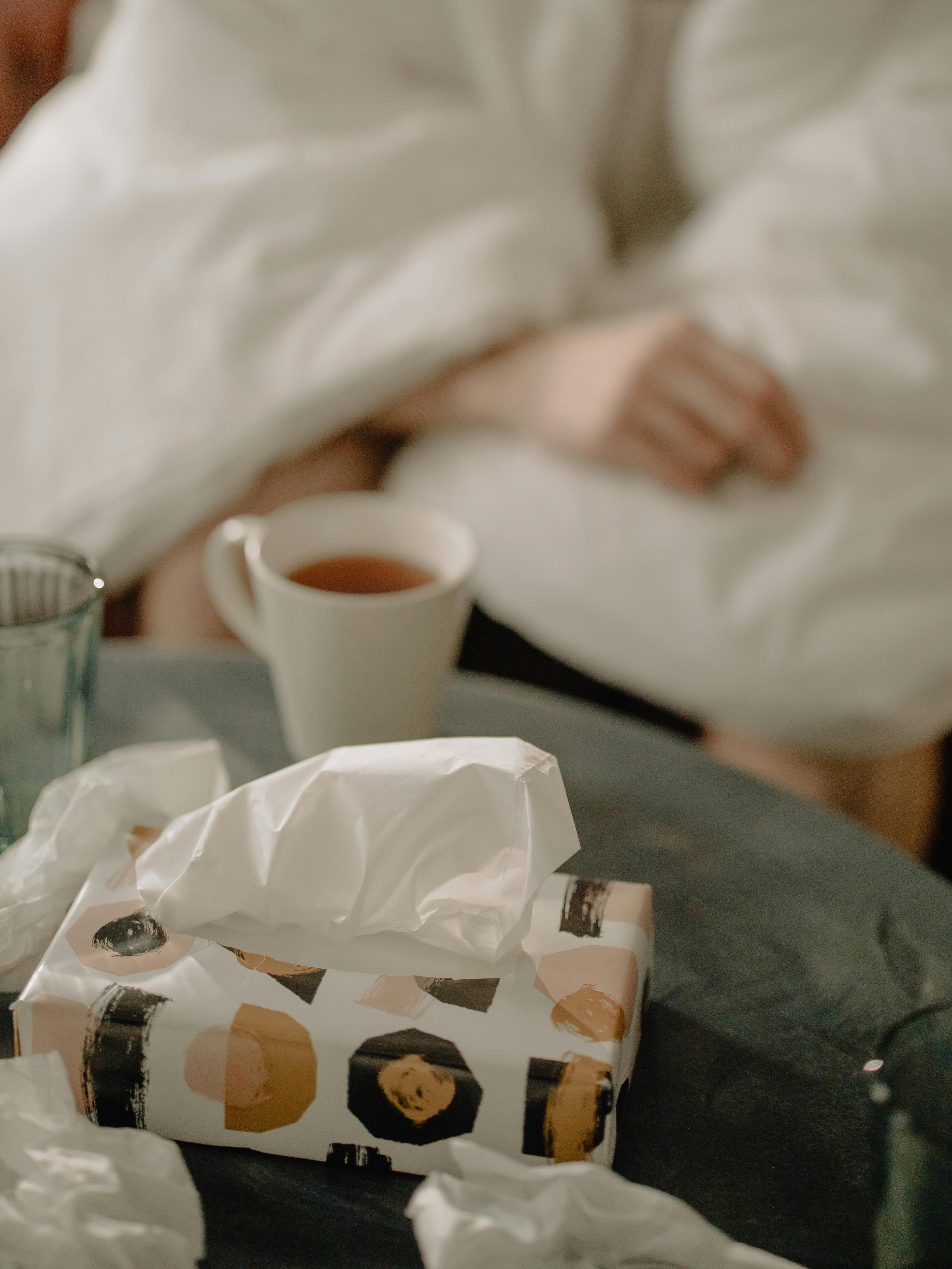
Photo description: box of tissues in the foreground, with a mug of tea and a person with their setup for dealing with being sick in the distance
I’m looking out the window as the snow comes down, at what looks like quite a vigorous pace, outside. I’m snuggled on my coach, laptop in my lap, cat snuggled under her blanket tent at my feet. I am getting work done in my business, fielding good news, looking forward to an Enneagram meeting where I know I’ll leave a little lighter and a little wiser than before. Life is good.
And yet….
I could just as easily write a different paragraph right now. Something like this:
I’m looking out the window as the snow comes down, at what looks like quite a vigorous pace, outside. I drink water frequently to keep from coughing from this post-viral loveliness that doesn’t want to leave me. The chill in the air and the lack of sunlight is depressing. And I look ahead to a meeting this evening, one I am looking forward to, but dreading the drive outside.
Some of us are extremely in touch with our emotions, but for most of us, I think there’s a spectrum. From those who never stop to consider emotions (theirs or others) to those who have tons of them, easily accessible at all times. I think I’m somewhere in the middle. Though I’m very in touch with how my body is feeling, I have to stop to contemplate where my emotions are at, most of the time, unless I’m just caught up in joy, or in rage (thankfully that one isn’t as frequent as it used to be!).
People can tell you to “think positive”. That’s usually pretty simplistic and dismissive, in my experience.
I prefer to choose joy. I can enjoy the wonder of a snowfall from under a warm blanket, with a snuggly cat. I can focus my attention on the positives I’m experiencing and on moments I am truly looking forward to, rather than focusing my energy on the negatives or on dwelling on potential negative outcomes in an anxiety spiral.
I can fear the unknown in the United States and around the world. Or I can celebrate the positive steps I took to make a difference this week, from sharing advice and lending an ear to reaching out to my senator to ask him to say no to the bill eliminating the Department of Education, and signing a petition against confirming a problematic politician.
I can focus on the uncertainties of self-employment, or rejoice in how freeing it was checking a bank account and seeing passive income from Black Friday purchases of my husband’s Play the Ukulele! course.
There’s no right or wrong here. And it’s so easy to see negative, and to get caught in dualistic thinking. But life is truly both/and. It’s scary and it’s beautiful. There’s love and there’s fear. Where will you focus today?
P.S. I’ve gotten much better at navigating, learning from, and simply recognizing my emotions since I started studying the Enneagram. I shared more about how to work with me, using the Enneagram or otherwise, last week.
One of my favorite reads this year has been The Myth of Normal: Trauma, Illness, and Healing in a Toxic Culture by Gabor Mate. It’s a long book, and I’m still working my way through it, but it’s the most comprehensive acknowledgement I’ve found of the complex factors that make our lives challenging as well as the varied ways, from individual to systemic, that healing is possible for us.
In the book, Mate refers to the concept of healing as a journey toward wholeness:
“It is a direction, not a destination; a line on a map, not a dot. Nor is healing synonymous with self-improvement. Closer to the mark would be to say it is self-retrieval.”
Self-retrieval.
What if we could find ourselves again? What if we could work through the suffering, make some changes, change our perspective, and ultimately return to ourselves?
To the beautiful self we were before the world hardened us, changed us, wounded us?
To the wise, sage being underneath all those layers of personality we put on as self-protection?
To the sweet, kind human obscured by our saboteurs and our sabotaging thoughts?
What would a journey of self-retrieval look like?
Conventional thoughts around healing might make us focus on the physical path toward healing: get some rest, take some medicine, eat some healthy food, get some exercise or movement into our day.
But if we’re on a journey of self-retrieval, that kind of healing would also include our mental and emotional needs. Maybe that’s therapy, spiritual development, coaching or yoga. Maybe it’s art-making or finding joy, fostering meaningful friendships and connections or joining support groups. Maybe it’s an afternoon with tea and a journal, or pounding a pillow, or grieving the loss of a loved one or an opportunity or a career that could have been.
One of my coaches emphasizes the importance of play – finding joy in the things we once did as children, or the things we wish we’d have had the opportunity to do as a kid. So for me, self-retrieval might mean cultivating play: purchasing a jump rope, swinging on a swing, coloring in a coloring book, or dancing around my living room or in a dance studio.
What does healing as self-retrieval mean to you?
My Enneagram teacher, Suzanne Stabile, has a book called The Journey Toward Wholeness. I recently re-read it with a cohort of other students of the Enneagram. The conversations have been revelatory. The Enneagram remains my favorite tool for self-retrieval or healing.
It’s so easy, amidst a busy day and week and life, to stick to the status quo and say no to new opportunities. But as Suzanne says in her book, “Even when there is much to do, we must first guard our souls.” I highly recommend joining an Enneagram cohort (my next one will start in the new year) or, if you know your number, a group like my Enneagram Book Club, to further your own work toward self-retrieval.
Do you agree with Gabor Mate, that healing can be seen as self-retrieval? Does this have any implications for you in your own journey?
If you’re feeling a lot of emotions or going through changes in your life, now might actually be the best time for you to seek a community as you navigate your healing journey. And wherever you are in the journey, I wish you all the best.
I’ve always found myself caught between two sides of myself in keeping my place organized. One part of me is an aspiring minimalist, with a keen awareness of the gift of calm and peace I feel in a clean, tidy, and simple space. Other part of me is a pack rat, wanting everything organized in its place but seeing a need to hold onto everything, and with a brain so busy with activities that I seldom want to stop and tidy up.
If I put much (read: any) weight in astrology, I might ascribe this to being a Gemini. I do put some of it up to my nature as an Enneagram 1: my perfectionist tendencies are ingrained habits and coping mechanisms from way back in my life. In my mental fitness work, this would be my stickler saboteur coming out to play. Like so many 1s, we want structure, but we also rail against it, especially when it seems like no one but us knows how to do it correctly. Aren’t brains delightful sometimes?
Regardless of the habits or emotions you find popping up related to cleaning and decluttering, I love this tip I gleaned and shared in the midst of a decluttering phase early in COVID:
When you’re decluttering, always start with the most visible clutter.
It’s not rocket science, but how great is this suggestion? If guests enter your house through the front door, that means EVERYONE will get that view, even if they’re just popping their head in to pick up a package or drop off a meal.
So when you’re ready to declutter, always start with the most visible clutter: you know, the stuff you can see when you open the front door to come inside.
You know the brilliant thing about this tip though? It applies to both decluttering and to our daily lives in general.
In the physical realm, if we start with what’s most visible, we’ll see progress immediately, and even if we get distracted from our task, if someone shows up at the house, they’ll immediately get a cleaner view than they would have otherwise.
In the same way, if we’re feeling overwhelmed by all of the tasks on our to-do list, one helpful method is to start with what’s most visible. If there’s an item that’s been on our list, haunting us, for two months, knocking that thing off the list a) means we won’t be wasting any more brain space or time worrying about getting it done and b) means we can knock it off the list. Chances are that it was taking up more than its fair share of space, and having that done will be super helpful.
Likewise, if I’ve got a million things to do, but I keep putting off making a priority list, that’s the most visible thing that will be a huge help. If I do that first, I’ll be able to see the items that are essential and urgent and prioritize them accordingly. If the most visible thing is that I haven’t updated the family calendar or made the doctor’s appointment that’s required of me, maybe it’s that. But the same idea holds. Consider what’s most visible, or most present, and start there.
While my mental fitness work has me in a pretty great space right now, anxiety is always an old habit my brain can hop to with ease. When there’s extra on my plate to navigate, anxiety means that clutter that normally wouldn’t bother me can feel overwhelming. (I ignore the inner critic and judge in my head under great circumstances, but if I’m tested enough, the anger can say hello! Yes, I’m a textbook Enneagram 1, and my strickler and judge saboteurs are especially strong, and these patterns will always be available to me if I let them.) But the flip side of it is that when I make some time to declutter, I feel palpable relief, basically immediately, and my anxiety gives me a break for a while.
While the visible clutter isn’t always actually the most important thing on our list, it can give us the mental capacity to tackle other things on our list.
If your email inbox is freaking you out a little bit on the daily, it’s time to set a timer and do a bit of decluttering there.
If those dishes are taunting you while you’re trying to work on your side hustle, it may be more effective to do those first, or at least delegate and pass it on to another family member.
Don’t underestimate the power of tackling that visible clutter. And the reverse can be true as well. If you start with the invisible clutter (you know, the stuff in your cabinets), you won’t get the visible satisfaction of seeing and showing off your progress after a decluttering session.
Likewise, the invisible brain clutter may include tasks that, while nice to tackle, are ignoring the elephant in the room, or your brain, metaphorically speaking.
So, I challenge you – tackle some clutter this week. Physical or otherwise.
If you’d like to learn more about the sabotaging thoughts in your own brain, getting in the way of your own projects as you aim to create a life you love, let’s talk! I offer a free saboteur assessment, and you can learn more about it and book a time here.
Thanks for reading, and have a great week!
P.S. Grab a copy of my Four Steps To Your Dream Life Blueprintwhile you’re at it. Giving yourself the gift of organizing and transforming your future is one more way to declutter and grow!
This article is based on an article I originally published on February 5, 2021.
Soul clutter. The cobwebs keeping you from making meaningful connections. The dust hiding your true desires. The distractions and disappointments. It’s both poetic and real.
“How am I regularly getting rid of the soul clutter I no longer need?”
Emily P. Freeman shared this prompt in her book The Next Right Thing, and I LOVED it.
How powerful is that?
What are you holding onto that you can let go of? What stories, what taunts, what hurts, what old patterns aren’t serving you any longer?
As she goes on to say in her book, it’s not that you shouldn’t hold onto anything, but that nothing should have a hold on you.
When we can let go of the stress of extra obligations, when we can declutter and destress and clear the decks, it’s in the stillness that we can hear our inner wisdom.
Clearing space, away from technology, away from the voices of others telling us what is or isn’t right for us, we start to hear that inner knowing. That’s when the wisdom comes. That’s when the answers appear.
Have you carved out any time for stillness or silence this week? When you do, what do you hear?
And if you know this is something that will benefit you, but you’re struggling to do it on your own, I’ve got your back! Reach out to me for a no-obligation conversation as my gift to you, where I can help you to move the needle on what’s keeping you stuck, so you can feel happier, calmer, and more equipped to lean into what only you can do in this world.
I’m also looking for people interested in studying the Enneagram with me. You can either begin your Enneagram journey with me or, if you already know your number, you can join our book club, which meets on Mondays once a month at 4:30 p.m. ET/5:30 p.m. AT. The Enneagram is my favorite tool for understanding our personalities, why we do what we do, and how we can break the cycle. I’d love to share it with you. Contact rossandjamieadventure at gmail.com to learn more. Scholarships may be available for those who qualify.
Wishing you a day and week with joy, wonder, meaning, and the space to do what is uniquely yours to do. Take care.
This article is based on an article I originally shared on December 18, 2020.








 Crafting The Life You Want: A Practice in Living