

Do you consider yourself to be a religious person? Or a spiritual person?
It’s something that I’ve struggled with somewhat for as long as I can remember. I’ve always wanted to have faith, to have a certainty or sense of knowing or trust about what’s coming.
I grew up Episcopalian, aka mainline Protestant, aka Christian, in a fairly liberal, “low” church that saw more diverse families than I ever saw in my classes at school. It wasn’t unusual for our pastor (a woman) to have us dance around the church, singing a song that wasn’t in our hymnal, or have us engage in discussion groups during worship.
Nevertheless, even with her occasional elaborations and interpretations of the beautiful Episcopal prayer book, I still grew up with a fairly “by the book” religious education.
Going through confirmation classes, I did my fair share of questioning, but I’m also a rule follower, so it didn’t occur to me to do anything but complete the classes and get confirmed in the church.
When I went to college, for the first time I felt like I had a wide variety of options for where and how I would worship. Some of my friends became Pagan (intriguing, though it never occurred to me at the time to seek it out), but after trying out an Episcopal church service in town (nice, but nothing too memorable for me), I found my home at our college Protestant services.
These ecumenical services brought together students and staff from very diverse backgrounds, and they were designed to give everyone a little taste of the familiar. So we’d sing a “traditional” hymn or two that I might have sung growing up, and we’d have a praise and worship part of the service, led at the piano by our Black pastor who had grown up in the African-American Baptist tradition and gotten his bachelor’s degree in music. For that section of worship, there was no need to hold the hymn in our hand – the pastor would call out the lyrics and we’d follow him for the cues.
There might also be another hymn or two from a different hymnal, and perhaps we’d have a guest performer, and every other week, I’d sing with the gospel choir, where I was usually the only white singer and learned every song by ear – an incredible contrast with my strict, traditional, white, Western music education. It was a wonderful immersion in another culture and a new experience for me.
I’d stand on the stage with the choir, singing gorgeous music that filled and uplifted the space, and I’d be in my element. Afterwards, people would come up to me and say how transformed they were by my solo, or how much they enjoyed our performance, how moving it was.
I always wished it would move me that way. I felt like something was missing, something was wrong with me. To be fair, music did sometimes give me glimpses of God, just brief moments, when all the musical parts would come together perfectly. But otherwise, I’d always feel like there’s something wrong with me. Jason Robert Brown describes it well when he requests, “Let the music begin.” and “Longing to feel what you feel…music of heaven to open some path to your soul and let something glorious in” in his song “The Music of Heaven”.
After leaving the utopia that my bubble of a college experience was in many ways (definitely lots of privilege there), I spent the next year traveling the country with a children’s theatre, followed by a few additional years of searching when I settled down in New Hampshire. In weeks that I had some flexibility on a Sunday, I made a point of checking out a local church (in hopes of finding the connection I’d been seeking). I enjoyed the contemporary Christian experience from a music standpoint, but I found it didn’t resonate with me in terms of beliefs. I found lots of mainline Protestant services that reminded me of home (similar, but different), and I got angry at the Catholic church a couple of times. I also had a couple of truly frightening interactions that I won’t get into here.
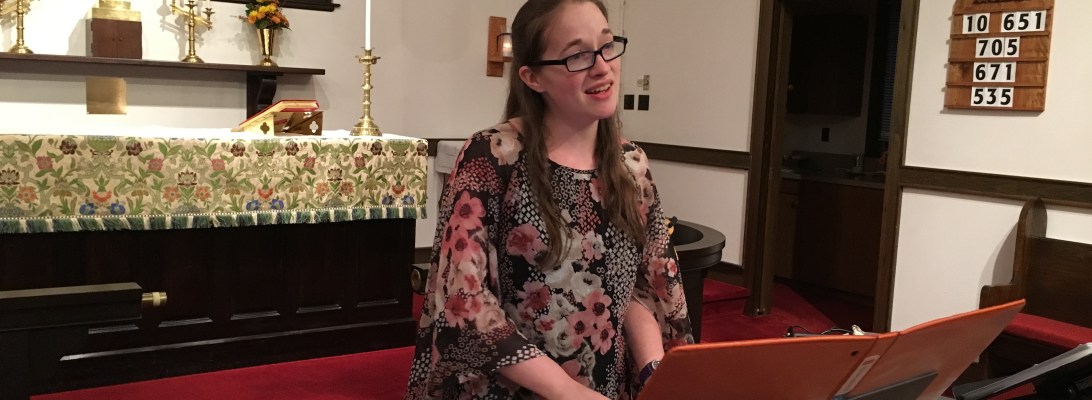
Later, I found a ton of satisfaction as the accompanist at churches I found a home and community in. I loved the communities I worked in, and in addition to those occasional transcendent music moments, I was delighted to help other people find those connections to God through my music.
In more recent years, I’ve loosened up my definition of spirituality. Maybe I’m never going to feel that clarity I’m seeking every Sunday. Maybe it’s more a question of creating a practice of contemplation, where I seek wisdom, get in touch with my inner knowledge and seek connection with the universe. I connect with nature. I read. I engage in challenging conversations. Creating sacred time for myself each morning has evolved into one of my favorite things about my day, and I’m so thankful to have a morning routine that truly lights me up and makes my day better. I’ve also been getting to know my local Jewish community, an aspect of my heritage I was rarely exposed to as a child.
Working with my clients, I’m finding it’s really important to encourage them to take time for themselves to check in and be still each day. We all need that time for ourselves, and the consistency of a morning (or evening) routine offers us so many benefits. For some it’s meditation, for others prayer or reading and journaling, but it is essential.
Do you aspire to have a consistent morning practice? If you’re working to create the life you want, it may feel daunting to acknowledge where you are now compared to where you want to be. I encourage you to take one small step today to get aligned with your dream life.
Does the dream version of you make time for a prayer each morning? Practice gratitude before bed? Take a walk outside? You may not have the car of your dreams, or the abundant bank account, or the dream schedule or supportive friends or loving partner, but I’ll bet there are steps you can take today to make your present more like your future.
So while spirituality or religion isn’t a requirement as you create your “dream life”, or a life that you love, it’s important for all of us to have some grounding practice that centers us each day. And honestly, sometimes even very religious people, or those who appear so on the outside, aren’t taking enough time to do the work on the inside.
If you’d like help with this, let’s get on a call to discuss how I can help you get there.
Do you have a sacred practice? Does it light you up? What’s one change you can make this week to get you even more aligned with your future and best self?
This is based on an article I originally wrote and published on December 11, 2020.

 Crafting The Life You Want: A Practice in Living