In brainstorming what to explore here, some weeks it just comes to me. Other weeks aren’t as obvious. Today, I asked myself what I needed to hear right now, and that’s how the title came to me: let good enough be good enough.
Photo of assorted flowers and trees in a neighborhood park by Jamie Feinberg
According to the Enneagram, a tool for personal growth I’ve been studying for more than five years now, some people (known as Type 1s) heard a very particular message when they were children – “it isn’t okay to make mistakes”. In spite of the best intentions, so often, in our families of origin, we manage to internalize the idea that there’s a problem if we make mistakes. So as a protective mechanism, some of us become perfectionistic. And yet when we do so, this overfocus on perfecting ourselves, perfecting those around us, or being a great role model for others means that we lose ourselves along the way, becoming less confident and unbalanced as a result, and more obsessed with control, repression, and worry.
But we don’t need to be a “type 1” for us to pick up the message that it isn’t safe for us to make mistakes. Maybe it’s because of the color of our skin that we’ve internalized that message, or maybe we have a neurodivergent brain that isn’t understood by those around us. Maybe a domineering parent or an unsafe environment at school or at home contribute to it.
One of the things, therefore, that I benefit a lot from, and that you may too, is remembering that most of the time, it’s best to let good enough be good enough.
In my mental fitness work, we say only 20% of tasks, at most, need us to do them perfectly (or close to it). For the remaining 80% of tasks, the healthy and reasonable thing is to let good enough be good enough.
Especially when I’m feeling stressed or navigating a lot of extra potential stressors already, I know I need to remember and heed this message.
Here are a few ways I’ve “let good enough be good enough”. I hope these inspire you and you’ll try it on for size:
Have time for a fancier meal? On the fence about whether it’s worth it to put in the extra effort? Keep it simple. Your body and mind will thank you later.
Not sure your wording of that email is perfection? Is the email being sent to someone who already knows your work? Can you afford to have an imperfect word or two in this email? Let it go, and send it.
Struggling to choose the right outfit for a night out? Consider the “needs” involved, and then just choose something. It doesn’t need to be the best outfit you’ve ever worn. Let good enough be good enough.
Prioritize cleaning the most highly-trafficked areas and the most visible ones in your living space. No one but my husband and I have to put up with a messy bedroom, so it isn’t usually a priority.
Showing up to a meeting less prepared than usual is still (usually) better than not showing up. If it’s still a value add, I show up – and I include a brief apology if it feels called for.
Didn’t accomplish all my goals today? Didn’t get outside as much as I intended? Didn’t get to finish that project? No point in beating myself up about it. Let it go – I did good enough (or well enough) today.
Does this resonate with you too? Is “let good enough be good enough” helpful for you? And if not, what do you think is the message you’d benefit from hearing or repeating right now? And if you know your Enneagram number, has that helped you to get clear about this?
P.S. If you don’t know your number but would like to learn it in the company of others on their own personal journeys of growth, learn more about working with me here. And if you know your number but are still seeking community, I lead both anEnneagram Book Club and mental fitness groups.
Anyone else finding the juxtaposition of life confusing right now? It’s such a gorgeous time of year where I live, getting to have so many sunny days, enjoying warmth and blue skies, flowering gardens, and some really delicious fresh and local foods, from lobster to strawberries and from garlic scapes to new potatoes.
And yet, I’m also making phone calls to my representatives to tell them they need to do everything in their power to stand up against concentration camps being built in our backyards.
What to do, in the face of it all? How do you keep moving forward in your own life when you know what’s happening in your backyard?
Photo description: Magenta-colored flowers catch the light, with their green leaves behind them (Photo by Jamie Feinberg)
You know what you need best, my friend. But here are some ideas, if things are hazy and it feels like the walls are closing in:
Return to the self-care practices that have gotten you through tough times in the past. Feel regulated when you take a shower? When you go for a run? When you call a friend? Prioritize that.
Practice presence, several times a day, but definitely when you begin your day. Pay close attention to your five senses. Feel yourself in your body. Focus on your breath. Release tension. Release negative thoughts.
Cultivate movement in your life, at whatever level is feasible for you. The more movement, typically, the better you will feel. I know for myself, the more intense it is, the bigger a difference it makes, but just walking or even getting outside can make a difference.
Find the sky. Remember when you see the clouds or tops of buildings or find the sun or blue that there is something bigger than you in this world – whether it’s a divine presence or simply a giant planet and universe that will long outlive you, tune in to the gifts of that, and remember you’re one person, doing your small part, to make a difference today.
Give back. Call your representatives. Protest. Create art. Talk to people. Stand up for small injustices and micro-aggressions. Do not normalize atrocities. Talk about people as if they are human – because they are.
Feel gratitude for something. Or several somethings.
Take breaks from social media. Take breaks from noise. Just be.
Find community. Join a group or start one. (Join one of mine!) Get connected and remember that sharing our gifts and our presence is a meaningful way to be the best we can be in the world.
Remember you’re not alone. Thank you for being you, and for doing what you have the capacity for today, in your own world and your own community.
And I’d love to hear how you’re doing right now. How are you handling this? How do you want to handle this?
Hi friends. In the face of an increasing number of horrendous headlines, including (as I write this) the news that transgender service members were referred to as “dishonorable” by the Supreme Court and the ban on transgender people serving stands, I am going through waves of emotions.
But after reading those headlines, I forced myself to walk to the mailbox, and you know what? I felt joy. I felt gratitude. The sun was overhead, it was warm enough for me to walk outside without a coat on, the birds were chirping, and so many beautiful flowers were blooming.
So in thinking about what to write today, I’m reminded of the progress I’ve made on my book – as well as the realization that I’m still potentially years from seeing it out in the world.
You know something kind of unique about me? Before I wrote this book, I nearly wrote another book’s first draft. Yes, I have at least ¾ of a memoir about a particular summer of my life in professional theater sitting in the cloud.
Something that I’ve learned about myself, in my Enneagram and in my mental fitness studies, is that I as amazingly creative as I am, when I take on a really big project, and when I don’t have accountability, and when it’s for me, and not for someone else, I may not finish it. It’s not something I’m proud of. It’s my “shadow side”, as they say. You could also call it my “restless saboteur”, or what it looks like when I am in “low 7” according to the Enneagram.
Not doing anything with this book is just one of many of these projects. And this will probably blow the minds of some people who know me and can rattle off all the things I’ve accomplished along the way. But I think that for me, when we’re talking about how to take a book from first draft to finished product, there was really a feeling of being daunted by what I didn’t know. Combine that with the realization that this particular book didn’t actually have a clear purpose for me in my career, and I let it sit on a shelf instead of focusing my energy on sorting out next steps.
But this time, my friends? This time will be different.
I think I first announced to the world publicly that my book Crafting Our Life Adventure would be published years ago. I even created this sales page so you could sign up to learn when the book is ready. (Still works!)
But you know what? Publishing a book is a giant task. And it’s tough to stay motivated on a giant task when you’ve got several or dozens of other tasks, many of them urgent, demanding your attention.
You may have heard this advice before:
“How do you eat an elephant? One bite at a time.”
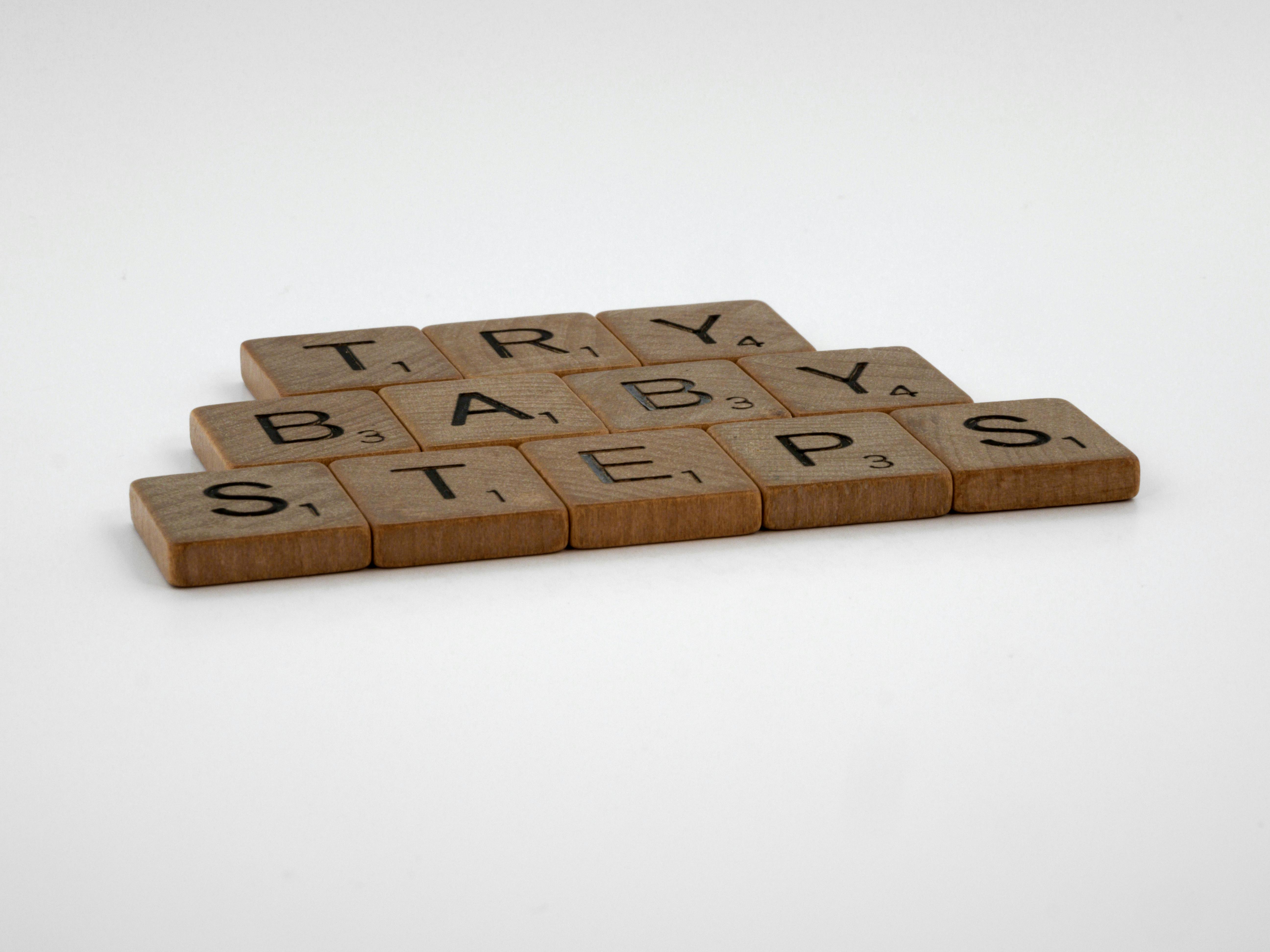
Photo of tiles with the letters spelling “try baby steps” by Brett Jordan
And so while last time, I let myself get pulled toward easier and/or more pressing wins than publishing my book, this time is going to be different.
I started out with the knowledge that I needed to sort out what the steps actually will be for me to publish a book.
So over the past couple of weeks, I’ve been asking friends and friends of friends for all of their tips.
After I have all that research “done”, or at least feel MUCH more informed than before, I’ll be using the research to create a checklist or road map for myself, outlining the next pieces of the puzzle and giving me smaller wins that I can celebrate along the way.
And finally, I will begin taking daily, or at least weekly, steps to realize my vision: to have my book published and out in the world.
This process is actually a process I repeat over and over again in my life. If you want to read it for yourself and reference it in the future, you can. I call it the Four Steps To Your Dream Life Blueprint, and you’ll find it here. I’ve used it throughout my life to accomplish my goals, and I hope it helps you too.
And it can work for anything, I think.
But if that’s too much, to look at all four steps toward a big vision, just focus on breaking your task up into smaller pieces.
Find taking a shower too hard today? Break it up into smaller steps. Gather your towel and toiletries. Gather clean clothes.
Want to reach out to your rep but not sure what to say when you call? Break it up into smaller steps. Write a list of bullet points to cover, or even write yourself a script. Practice saying it out loud to yourself.
Know you need to do some batch cooking, but feel overwhelmed? Break it up into smaller steps. Grocery shop with a few meals in mind, or roast some veggies and rice and a protein that will make it easier to make dinner from there.
So I hope that’s helpful. At minimum, breaking a daunting task into small steps is really useful for me. And if you have the brain space to think about the big picture right now using your wise mind, feel free to grab a copy of the Four Steps and give it a try.
And if your brain isn’t allowing you to tap into your wiser self right now, I 100% get it. And if you’d like some support in doing so, schedule a Saboteur Assessmentwith me. I’d love to help you learn to let the sabotaging thoughts, the ones that get in the way of living a life you love, go.
In stressful situations, we tend to default to old habits and/or move into survival mode to keep ourselves safe. All of this is completely understandable.
Because we’ve all had different experiences, have different brains, differences, personalities and more, what one person does under stress can look quite different from someone else. It’s part of what makes us unique. But what isn’t unique is that we are all hardwired to do certain patterns of behavior under these circumstances.
In thinking about the state of the world right now, I’m especially aware of how dangerous traveling is for so many people right now. Perhaps you don’t feel safe traveling internationally (or at least, you don’t feel safe crossing the border to get back in). Perhaps you don’t feel safe going to the grocery store or even leaving your home.
The situations may be different, and the reasons may be different, but in any of these circumstances, the goal is for us to be able to stay calm under pressure. We want to know that we will be calm and in control of our actions, even if we are being interrogated or profiled or otherwise threatened.
So I want to talk a bit about what happens to us under pressure, and how we can strengthen our practices and our minds to help keep us safe (or at least increase the likelihood of a positive interaction) in future encounters.
Photo of blue sky and branches by Optical Chemist
I’m going to do so with compassion for others in challenging circumstances, to the best of my ability. I’m going to do so using the lens of the Enneagram and mental fitness. As usual, please keep in mind that I’m not a scientist or a therapist, and what I’m sharing are my own opinions based on my own experiences. If you want the technical scientific jargon, I probably won’t be going there, and I’m also not a lawyer or a therapist, so consult your own if possible and do your own homework and come to your own conclusions.
My personal belief is that we all have some sort of wise, wonderful being inside of us. Maybe you’d call it your soul, or your sage or your wise mind. This special being is there from the time we are born. As soon as we’re born, basically, we start having experiences in the real world. From the noises and feelings when we first leave the womb, to the ways our family of origin treats us, to the kind and the harsh and the horrible humans who cross our paths along the way, we are challenged.
As a result of these experiences, we start developing a personality. We pick up traits along the way. We find that we get positive reactions or are safer more frequently when we do certain things, so we lean into those more. In the language of Positive Intelligence, the mental fitness program I use in my training and coaching, we find that some of our skills and characteristics serve us well, so we do them more and more, eventually resulting in some “saboteur” behaviors. We might discover people-pleasing tendencies, or a hyper-achiever who tells us we must keep “doing” or we don’t have value. Maybe we develop restless or avoider or controlling saboteurs as ways of coping with the world.
In the language of the Enneagram, by the time we are adults, we’ve settled into a grab bag of personality traits that sometimes help us and sometimes hurt us, because we overly rely on them. They trap us. If we study the Enneagram, we’ll learn that there are other people in the world very similar to us, whose personality types are also aligned with ours, though our own individual circumstances and that underlying soul within us means we’re still all different people.
Whether we’re using the language of mental fitness or of the Enneagram, if we are privileged enough to begin working on ourselves, it begins with non-judgmental self-observation and a recognition that we’ve been holding so tightly to these personality traits and behaviors that they are no longer serving us. We recognize that if we want to become more of that beautiful soul, more of that lovely sage being, so wise and as we were created, we’ll need to let go of the grip that our personality holds on us.
And if we’re able to see this, whether it’s because we did a saboteur assessment or read a book or experienced a life-altering circumstance or something else entirely, then we’ll find ourselves asking the question: what’s next? How do I step out of these habitual patterns that I’ve been in for so long, that have me trapped in my own patterns of personality?
The answer, in a word? Presence.
When we are able to let go of the sabotaging thoughts and judgment of our own mind, and instead practice being in the present moment, it’s the first step toward our own self-actualization.
It sounds lofty, but if we are able to practice, day in and day out, being fully present where we are, whether that’s by getting outside in nature or fully savoring a meal or feeling the water on our hands, we are, step by step, loosening the grip of our personality and making it easier for the wisdom of our wise mind to make it to the surface.
You may be wondering what the heck this has to do with staying calm when we’re traveling. That’s fair!
But it has everything to do with it. If we practice grounding ourselves, using any tools of mindfulness, while letting go of judgment, we are increasing the likelihood that when we encounter a stressful situation, we will be able to hear the wisdom of our wise mind. We’ll increase the likelihood that we will know how to best take care of ourselves in that situation. We become calmer, and wiser, and less anxious. Our wise mind will recognize whether we need to go hide, or explore a solution, or fight back, or simply have the words to answer a question calmly and in the wisest way possible.
We don’t usually learn to do this work. We are rarely, if ever, taught these skills in school. We are not taught that our mental muscles need to be strengthened and exercised just as much as our physical muscles do.
If you’re curious about this, I’m pleased to offer a Saboteur Assessment, without cost, to anyone interested in learning more about how they’ve been getting in their own way. Whether or not you choose to work with me in the future, I’d love to help you gain the understanding to move forward in the world without being held back by your own patterns of personality.
I can’t control what happens to you when you travel. But I’d love to empower you with the tools to control as much as you CAN control in your life.
Feel yourself wherever you are. Whether you’re standing, sitting, lying down, feel yourself on the surface you’re on. Touch an object (maybe try this device?) and observe the temperature and texture of it. Notice fine details you haven’t noticed before.
We are still here, friend. Let’s celebrate the little wins. You made it to today.
Photo of a monarch butterfly on a branch by Erik Karits
As much as there continues to be more horrendous news, I am seeing signs of progress regularly this week in the fight toward defending human rights and preventing more atrocities. Read on for more of the progress I am seeing ( in the United States, predominantly), if that interests you. And if not; go find some joy, and keep breathing! You’ve got this.
More signs of progress:
The unelected billionaire seems to be displeasing the Rump – or at least, seems to be leaving the prominent position he’s in. While I don’t trust any of that being simply face value, I am happy for signs of tension in that relationship. Cautiously optimistic, I’d say.
A great win in the courts in Montana this week for transgender and intersex (and any gender-noncomforming folks who might also be persecuted) folks in Montana. Their extreme bathroom bill was struck down!
Wisconsin’s election was NOT bought by Elon. His $25 Million could have gone so far, but instead he threw it at a candidate who was resoundingly defeated.
And while Florida’s election for two house seats was still easily won by Republicans, it was a MUCH lower margin than in November. Progress.
I’m also hearing more and more horror stories making headlines about visas being revoked. So while it’s disgusting that students and professionals alike are being deported or told to self-deport due to having an opinion the government doesn’t like, I’m heartened by how much people are talking about it and making noise about it to their reps.
And of course, I have to shout out Cory Booker, who spoke on the floor for more than 25 hours to make “good trouble” and make sure we know and understand that this administration is NOT normal and it’s NOT okay.
As I walked outside today before writing this, I enjoyed a gorgeous blue sky. I’ve recently booked another speaking gig and gotten myself a new part-time job I am thrilled about in addition to the beautiful mental fitness, coaching and Enneagram work I am privileged to share with the world.
I hope that whatever your own situation is, you’re finding signs of progress too. And if you have one, please consider sharing it with me!
Take care, and keep fighting the good fight. And remember, rest is resistance. Find joy. Be love. One step, and one day, at a time.
Curious about working with me? Want to learn more about what’s keeping you stressed or stuck? Book a saboteur assessment here, or learn more about the Enneagram here.
Gosh, it’s been a month of a week, and I have had a few days in particular where it’s been a struggle to keep myself grounded. On one of those days, I was working on some never fun bureaucracy type stuff, and it was triggering panic in my body, in spite of all the mindfulness work I was doing to work through it. I felt alarmed and had a day of important things to do, and as Ross tried to help me as we prepared for an important meeting, I realized if I didn’t get myself under control, I was bound to trigger him and likely have a rage episode.
So what does progress look like? In this case, progress was telling Ross I was going upstairs because I couldn’t get myself under control. There, I ran in place for two minutes to wear myself out. And then I just let my body settle down. As I prepared myself some lunch, I realized it had truly worked, and my body was grounded again. And thank goodness, because when a couple of hours later, I managed to spill water all over the kitchen floor washing dishes, I just laughed for a couple of seconds, grabbed a couple of towels, and cleaned it up. And when those kitchen towels weren’t enough, I headed downstairs for a bath towel, laughingly summarizing for Ross what I’d done in passing as he said he was sorry I had a hard time from the next room.
Friends, in the past, this would have had me raging and upsetting my husband, perhaps getting in the way of his ability to show up for our meeting. It would have resulted in me beating other people up and then beating myself up for hours, thanks to the judge in my head.
Instead? It was just a day, friends.
This is what can happen when we take those small, daily steps to instill better habits. I’ve got a mindfulness habit. I do group work using mental fitness and the Enneagram throughout the month. And I’ve cultivated healthy communication and listening with my husband.
There are signs of progress outside of my own life too. I’m especially inspired seeing the media coverage of some of the things ICE is doing (like detaining and basically torturing lawful permanent residents of the United States, citizens of Canada who never violated laws, and many more stories of what those profiled in the media have seen). Knowing that judges are saying no (even if the administration is trying to pretend that doesn’t matter) and that some of the anti-trans laws and actions are being struck down is promising.
Spring is my favorite season, because it is such a sign of progress. We get to see bits and bobs of life springing up from nothing. It’s so exciting and beautiful and encouraging after a long winter.
Wherever you are, whatever you’re facing this week, I hope you can see glimmers of hope. Bits of progress in your own life and in the world.
It can be really tough, even on the best of days, to pause and take a step back. Such a high percentage of our actions are done on auto-pilot: we’re not even stopping to think before we do them. It’s the way we always did them. The action precedes the thought.
Unfortunately this can also get in the way when we’re confronted by people whose views are different from ours, or whose words or actions are triggering us. We’re each bringing our own baggage to the table. We’ve got our own instincts, our own habitual patterns, and our own biases based on our own past experiences.
Photo of a person with dark long hair, in the grass facing the mountains with their back to us, by Badri Rai from Pexels
People often ask me how I can stay connected to people whose beliefs are so different from mine. It’s honestly a skill I’ve been honing since I was a kid. I think there are a few reasons it comes so easily to me:
I am the oldest child in a family of six. I learned to get along and go with the flow rather than fight the more aggressive folks in my family.
I’ve always been genuinely curious about people and why they do what they do. This curiosity means that rather than focus on the hurt someone is doing, I can invest some of my time and energy into curiosity about how it came to be that way.
I genuinely believe we all have goodness in us – and if I can’t find it, I have compassion for what may have happened to them along the way. (I have always had empathy, but my compassion has gone through the ROOF since beginning my mental fitness and Enneagram studies.)
I have always treasured close, deep 1:1 connections with people, and some of the best times in my life have been sharing those types of conversations. If a past friend, perhaps someone I’ve had a great conversation, or many, with in the past, is doing things that I don’t understand, I tend to assume the best of them, and again, get curious about how they got to be here.
I’m aware that if I can engage with someone whose opinion I don’t agree with by striving to listen and find common ground, it’s the best hope I have for potentially changing their mind down the line. If I stop speaking to them, I’ve lost my chance for them to recognize someone’s humanity or the fallacy of something they’ve held to be true.
When someone approaches me, full of anger or fear, shame or anxiety, I can recognize their saboteurs coming out to play. If I’m able to keep myself grounded and in a healthy mind state, instead of meeting their saboteurs with my own saboteurs (of judgment, of fear, of anger etc.), I can instead offer them an ear, or get curious, or take action to protect myself or others.
The truth is, because I am well-practiced at letting my sage mind run the show, instead of my saboteurs, I am much less likely to respond in my own patterns. I’m more able to find a win-win-win for everyone. I’m more likely to have a positive view of the encounter.
For instance, I could get upset if someone confronts me denying the harm a politician is doing and trying to do. OR, instead of getting upset, I could ask them clarifying questions, getting very curious about the fear hidden behind their comment.
Maybe if I was able to ask them a few questions, I’d learn that we agree on 90% of an issue, or even 50% of an issue, when I previously thought we were on opposite ends. Maybe I’d learn that I needed to do a little more research on a particular topic so that I’d be able to speak to it more articulately next time. Or maybe I could share a personal anecdote that would humanize the people we were talking about.
Whatever language you use to describe it, our saboteurs are real. Your saboteurs could be hyper-rational, or hyper-achievers, or perfectionists, or getting you caught in anxiety spirals. We all have strengths that served us at one point in time, but eventually we start overusing them.
And we don’t have to.
When you’re able to step back and see your saboteurs in the light of day, you don’t just understand other people better. You understand yourself better. And it offers you the opportunity to find ways to live that are easier, and kinder, and more fun, and with less judgment of yourself, or others, or your circumstances.
Saboteur assessments are transformative. It’s a free opportunity to shine a light on where you’re stuck and imagine what’s possible. We can learn to turn down the saboteur noise and let our wise mind run the show. And we can find how to live lives that we truly love, full of joy, even when the world gives us every opportunity for anger and fear and frustration and anxiety.
TW: for a frank conversation around my own struggles with food and references to diet culture
I’ve been studying the Enneagram for more than five years, and because of that, most of what I’ve studied feels quite ingrained and accessible. But with anything we learn, I think, there are layers, and as we go through new situations in our life and move further along our path (hopefully toward self-actualization), life has a tendency to throw us the same types of situations again and again, in hopes, perhaps, that we’re ready for a new lesson and can grow further as a result. A mentor of mine recently described this idea as a spiral path for growth, and I know that isn’t a new concept for many of us.
My relationship with food, of course, goes back much farther than my relationship with the Enneagram. My own relationship with food is complicated, with past experiences and challenges around food security, trust, and control. Add to that a hefty dose of diet culture in the 80s and 90s and throw in the fact that in the past eight years, I’ve realized I can’t eat gluten and have some other food sensitivities, and you’ve truly got a recipe for food issues, to say the least.
I could share a number of stories about the effects this has had on my life, and about how many therapy and journaling sessions I’ve devoted to it, but I had a particular experience this week that I found absolutely fascinating and couldn’t resist sharing.
Last night, while talking to Ross (my husband), I said I wanted to open the mint chip ice cream we had in the freezer and have some for dessert. He was supportive, of course. I’d purchased it on sale (it’s my favorite Chapman’s flavor) and I was looking forward to it.
Perhaps a half hour after we chatted, I realized I hadn’t yet gotten up from the table to get myself some ice cream. I washed my hands, grabbed a bowl and spoon, removed the ice cream from the freezer, removed the layer of plastic wrapped around the carton, and began scooping myself ice cream. The bowl isn’t especially large, as it fits in the palm of my hand, but it easily fits a lot of ice cream in it. I remember scooping some, and then more, and then more so it went over the top of the bowl, and then filling in some of the gaps, and then I’m sure I had my inner critic chime in that it was plenty and I’d want some later so leave some for the rest of the week. I put away the carton and grabbed my bowl and spoon.
It wasn’t until I set the ice cream down on the table that I looked at it and thought to myself, why is there so much ice cream in my bowl?
Common reasons I might have told myself I was having a large portion of ice cream in the past have included:
I’m really hungry
I’m having one of those days where nothing satiates me…ice cream will
I need more protein today (yes, that’s a real reason I’ve given myself)
I don’t want to leave a little bit in the carton
It’s a special celebration day
I’m at an ice cream place I won’t be back to for a while (or ever), so enjoy it now
This ice cream place is seasonal and closing soon – make the most of it
I’m having a tough day. Ice cream will make me feel better
I’m sure there are others as well. But do you know what I realized last night?
I hadn’t had ANY of those thoughts. Because I actually hadn’t stopped to think. At ALL. I’d had the gut impulse/light bulb moment/memory of my conversation with Ross which then sent me into the kitchen to get myself ice cream.
And then I brought it to the table. Then, and only then, did I look at how much ice cream I’d given myself and think, hmm, I’m not especially hungry. I’ve got some healthier habits I’m working on. I would have even been happier with a smaller bowl. Why in the world did I give myself so much ice cream?
And the answer, clear as day, that came to me, was because I hadn’t stopped to think.
At all.
So, if that isn’t making sense to you, congratulations! You’re probably not an 8, 9, or 1 on the Enneagram. You may not be a dependent number (a 1, 2, or 6) either.
These three numbers, 8/9/1, are in the “gut” or “anger” or “rage” triad. Part of what makes us unique is that we are dominant “doers”. We all rely heavily on “doing” as we go about our day, with different flavors for each number. As a 1, I’m predominantly “doing” when I am in my automatic, auto-pilot part of my being (which is most of the time, for most of us), with this doing fed by how I am feeling about things, though I may not be self-aware enough to be able to articulate the feeling underneath it. When stressful things happen and I feel things, I react to my feelings by doing. But the main thing here, when we’re in this triad, is that we are doers. We are “doing dominant”.
(Side note – 8s are doing dominant, supported by thinking, and 9s would be both doing dominant and doing repressed, but that’s a story for another day.)
Now, this isn’t a bad thing about myself; it just is. But the other piece of this puzzle is that as a member of the dependent stance (made up of 1s, 2s, and 6s), I am by definition thinking repressed. This means that I am less likely to do productive thinking than the members of the other two stances.
Members of the dependent stance are certainly thinking a lot, perhaps even more than others, but that doesn’t mean our thinking is necessarily productive. We are defined by the fact that it is a big challenge for us to bring up productive thinking, at least if we haven’t done a LOT of work.
So, as a person who thinks of herself (and is thought of by others) as a pretty smart person, I’ve had to wrestle a lot with how repressed thinking shows up for me.
And last night, my goodness. Is that not a perfect example of it?
There were so many times along the path from refrigerator to table where I could have stopped to think: Do I want a small amount of ice cream, or a large one? How hungry am I right now? I’ve got some health goals for the future – should I consider those right now? Am I having a strong craving? How would I feel if I didn’t eat ice cream tonight?
My friends, I thought none of those things. I simply got myself a big bowl of ice cream.
And honestly, if I hadn’t done a lot of work on myself, between studying the Enneagram and mental fitness (which has been my best tool for slowing down these auto-pilot moments), I don’t think I would have even noticed.
(This is also, more generally, a perfect example of the kind of automatic responses and habits built into our personality that require a practice of non-judgmental self-observation to be able to recognize it and potentially make another choice. The Enneagram and mental fitness are both beautiful tools for this.)
Of course, as soon as I observed myself at the table, it got me thinking. What factor has this behavior played when I’ve worked on losing weight? What factor has this played in changing my habits to healthier ones? If I could gain more awareness in this moment, perhaps even long enough to do a short mindfulness exercise, could I eat less each night? How would that feel?
I’ve let go of wanting to be a particular size, for the most part. My only holdout is a couple of beautiful dresses I will likely never be able to wear again. But I think I’m going to be okay with that. However, I want my future self to be as fit as I am currently. And I’ve realized recently, in part influenced by the book Outlive, that if I want to be this fit at 60, or at 80, I need to become super-fit NOW. Because our bodies have a tendency to lose muscle, and lose strength, lose stability as we age, the only way to set myself up for a healthy retirement is actually to get MORE fit than I would otherwise care to right now.
Obviously, to even think about doing that requires some privileges, and I’m not fully convinced if this is even a realistic goal for me in my life right now. But I do have it in the back of my mind as I explore steps I can take, and habits I can form, moving in that direction.
And I guess what I’m saying is, we talk about mindless eating. I don’t do that anymore. My eating is truly mindful. I savor each bite or at least one bite of each food I have on my plate, and I truly take my time and enjoy my meals. But only now am I aware of mindless plating!
Have you observed yourself in moments like this? If you’ve studied the Enneagram, did it teach you anything about your own habits you’d like to share?
This week has been busy, and honestly, this year so far has been too. I’m feeling myself simultaneously caught up in the energy of a new year, all the feelings of possibility (real or imagined) that that entails, while also facing a particular brand of challenge and potential stress that has historically been a major issue for me.
I have so much to be grateful for, to be clear. In addition to the majority of areas of my life feeling fairly secure and in a beautiful place, I’m well aware of the privileges I have in even being able to make these plans and work on these types of challenges, when so many nearby and around the world are worried about the essentials – am I safe? Do I have a place to sleep tonight? Is there food on the table? Is there a table? Are my loved ones okay?
But as you may relate to, it’s still quite easy to get caught up in your own challenges, even when they’re not as challenging as someone else’s.
One of the things I’ve been working on this week, because of this particular “challenge” I referred to above, is on two things, as I described in my Enneagram Book Club meeting last night.
The first thing is that I’m working to keep my attention on all the good stuff, the majority of the time. Focus on gratitude for all the stuff that’s pretty darn awesome in my life and even in the lives of others. I have so much to be grateful for, in so many areas. And while there are times when I get troubling news or am handed a surprise and need to spend some time processing my emotions, most of the time in my day to day, I get to choose where my focus is. And if I choose joy (as I have often spoken of), it’s likely that my day, and the day of those I encounter, will be better because of it.
The second, complementary thing I am working on right now, is being able to work on the “challenge”, the hard thing, without bringing negative emotions into it. This is something that my Enneagram work helps me with, but I think it’s my mental fitness practice, more than anything, that has me in a great mindset for this. Instead of anxiety about the outcome of what I’m doing, or anger at the situation I am facing, I’m exploring what it feels like to be curious and to just get stuff done. Can I set aside the critical and sabotaging voices in my head when they pop up, and instead return to the next task at hand? Can I marvel at my ability to get things done in a crisis instead of wasting my energy getting upset? Can I trust that the better use of that energy is in the doing?
Part of this, for me, is that I need to get comfortable being uncomfortable. I don’t like the uncertainty and lack of control I’m feeling about this situation right now. But when I’m honest with myself, I’ve never been a fan of change, and I really like to feel in control. And control is an illusion, my friends. So I’m working on embracing liminality and thanking the universe for a chance to get uncomfortable and learn more. To learn to work productively through discomfort, without adding drama.
One of the things my mental fitness work has taught me is that the wise part of my brain can be in “go mode”, or exploring options, or creating new solutions, without any negative emotions in the picture. And when I take that approach, what could feel daunting or overwhelming can instead feel more like I’m a little kid on a playground, making a sandcastle or peeking behind a tree or creating a new club for my friends to join.
So if you’re also in the midst of a big “challenge”, whatever that may be, I want to encourage you. It’s okay to be uncomfortable and in transition. Those spaces offer us beautiful opportunities for growth, if we choose to see them that way. (And it’s okay if it takes time to get there.).
Though you may not be able to change the situation, consider if a shift in focus, to a wiser part of you, might bring you some peace, or at least help you work more efficiently so you can sooner take a break with some tea or get a hug from a friend.
I’m grateful for mindfulness practices and self-awareness cultivated with the Enneagram that are making all of this feel more attainable.
I’m also grateful for the opportunity of a new year, where we can keep reevaluating who we are and our place in the world.
Thanks for reading, and have a beautiful week!
P.S. A great practice for the new year could be to book a Saboteur Assessment to help you shine a light on what’s keeping you from your best work and being your most authentic self. You can also reach out to me to join my next Enneagram study, using Suzanne Stabile’s incredible curriculum, so that you can learn more about yourself in the company of like-minded people.









 Crafting The Life You Want: A Practice in Living