Some wise people have said over the years that everything is either fear-based or based in love. In my mental fitness work, my coach has told us the same thing, reminding us that the wise part of our brain makes decisions out of love, while the saboteurs, the negative voices in our head, would have us make decisions out of fear.
As children, these saboteurs told us to do things out of fear of rejection, fear of abandonment, fear of death. And over time, we made that a habit. And those neural pathways are well-worn, with habits that are very hard to break.
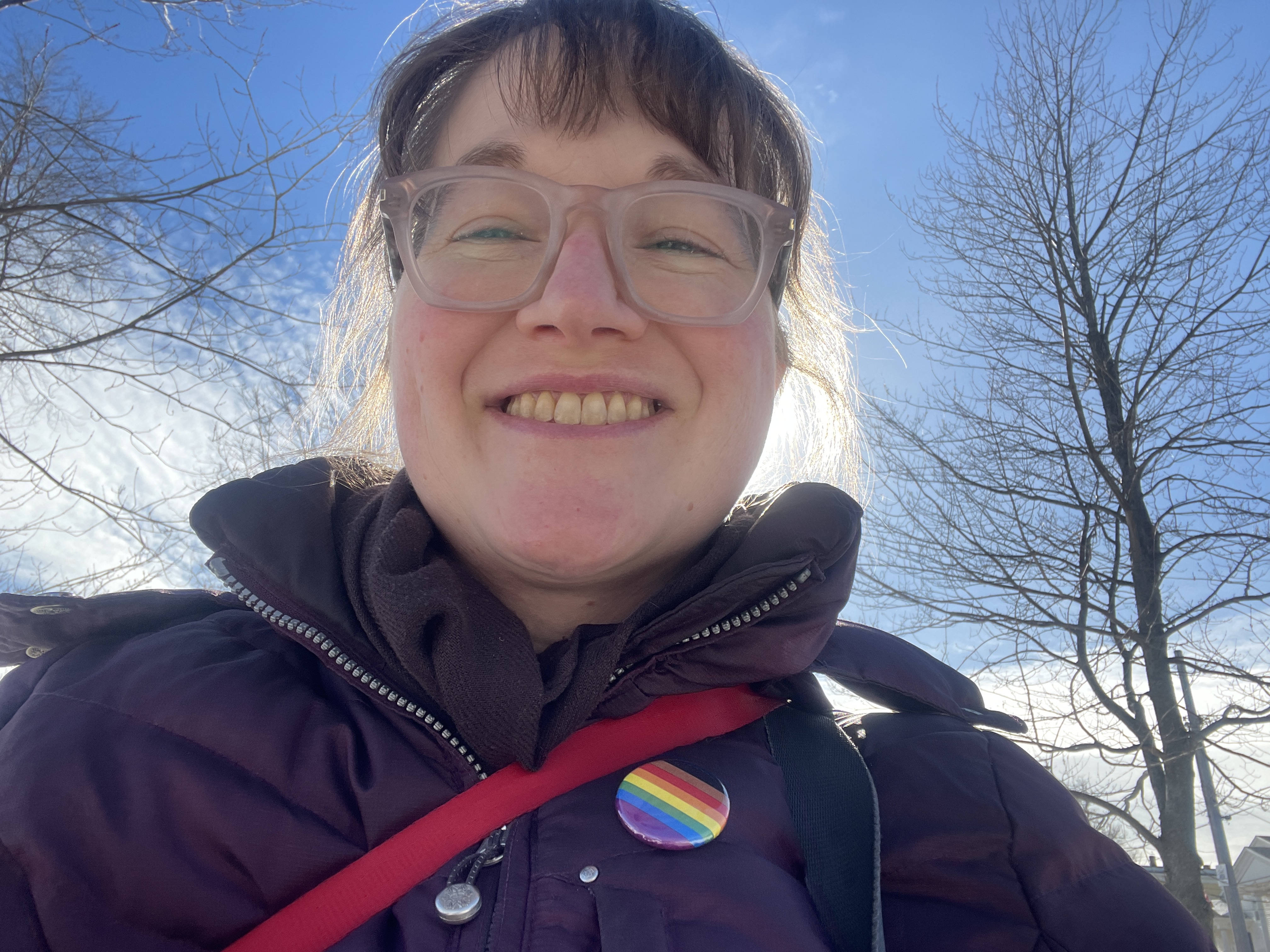
A silly, happy photo of me, wearing a purple coat with the red strap of a bag visible, sun and blue sky behind me, with a progress Pride button on my coat.
So, what’s the alternative? What does choosing love look like?
It might look like:
Listening to what someone has to say instead of reacting first
Responding with empathy or vulnerability instead of walling ourselves off
Exploring our options with a playful energy and a love for creativity or problem-solving instead of limiting ourselves out of a fear of lack and a longing for security
Getting ourselves outside or out in the world instead of letting our saboteurs dictate all the reasons for us to stay put or stay inside
Brainstorming with a goal of finding the win for ALL involved, rather than approaching each conflict as a potential win/lose or lose/lose scenario
Respecting boundaries, often of others, but especially of ourselves
Choosing love for me is often embracing curiosity. Embracing curiosity about why strangers might be doing things that I don’t expect or understand. Embracing curiosity about what would be possible, if I had no constraints or let go of my fears. Embracing curiosity about ways we can all find happiness, without taking it from anyone else.
So as I call my reps and support my neighbors and scream at politicians, I also work to pause. To breathe. Breathe first, and then respond, instead of reacting without a moment to process and ponder.
Where can you choose love?
And if this feels daunting, I have two beautiful ways that I support my clients which also can help you to find compassion, for yourself, your environment, and for other people.
My next group for people interested in learning more about the Enneagram begins in April. Join us on Tuesdays and Thursday evenings (Eastern/Atlantic time). Learn more hereand contact me, and invite a friend too.
And I’d love to support you in building your own toolbox to do this work. If you’d like to join me for an opportunity to learn some mental fitness skills and see how saboteurs are keeping you from living a life you love, head here.
Thanks for being here, and thanks for keeping at it, even when it’s hard or even feels impossible. You’re not alone.
Are you trying to find empathy for people you don’t agree with, but coming up short. Do you have the spoons to figure out how to go there? Read on. If not, that’s okay. This article isn’t for you, but others will be. This is for folks trying to listen with empathy to friends and family who they don’t agree with, and feeling frustrated about it and wanting to know how they can find some.
Over the past week or so, I’ve seen several posts from people who are frustrated with the polarization happening right now. They spoke of seeing extreme posts from folks on both sides of the aisle, and they wish that instead of sharing divisive posts, people would work to find empathy for the other side, and try to be compassionate in these times.
Photo credit of a protest crowd with a Free Hugs sign: Sides Imagery
I have a lot of compassion for people who are feeling this way. I know that the polarization is a problem. If we can’t treat each other with respect, how can we move forward as a country? Hateful comments aren’t solving anything.
But unfortunately, some of these well-meaning people, by making these comments, more or less saying “can’t we all just get along?”, are actually showing that they might be lacking in empathy for the people who are sharing more extreme views.
So if I’m on the far left, perhaps a trans person or an immigrant or someone doing everything I can to stand up for women and senior citizens etc., I might be feeling extremely fearful right now about the state of the United States or the state of the world. Don’t I deserve compassion for the fact that I share a lot of opinions I agree with? Even if some of them might come off as hateful toward billionaires or even of those who voted our government leaders into power?
And if I’m on the far right, perhaps someone who sees myself as self-made, or who is fed up with what I see as a bloated government, or with the way the deficit continues to grow, I might be sharing what feels like common-sense opinions or articles. I might be feeling happy that the government is moving in the direction I voted for. Don’t I deserve to have my own opinions and share them, even if some people might not agree with me?
I’ve found myself frequently wanting to comment on these “can’t we all just get along” posts to share my take on this. I want people to see the perhaps ironic reality that when we get angry at folks on both sides who aren’t willing to be empathetic to others, we’re also showing that we’re struggling to have empathy for people ourselves. (
I mostly refrain from commenting, though, because that in itself could look like I’m showing a lack of empathy for them.
It’s tricky, isn’t it?
I’d like to say I’m someone who never shares articles or posts on auto-pilot. I’d like to be someone who always pauses, ponders what’s the best use of my time, and posts only the most important things.
But that’s not true. I’m a human, and I am imperfect. And it’s especially challenging to always be thoughtful right now.
If you’ve ever caught yourself sharing posts on auto-pilot, reacting to the news automatically or going on a doom scroll, I’ve been there. When we do this, we’re doing so out of fear. Our saboteurs and the judging part of our minds are running the show.
But if we want to feel empathy or compassion, we can’t do so in that state of mind. The first step is to stop.
When you recognize you’re acting out of habit, or acting out of fear, or anxiety, or anger, stop.
Ground yourself. Feel yourself on the floor or a seat. Observe the temperature of your breath as you breathe in and out. Take note of the colors around you.
Once you’re calm, you’re then able to access the wise part of your mind, which is capable of choosing love. The wise part of you will know whether it’s time to run away, to go do something, to show compassion and connection with someone or find common ground, to speak up, or to explore other options to problem solve through this situation.
This wasn’t always easy for me, to try to step into someone else’s shoes and show them compassion instead of judgment.
But I have had a lot of practice with empathy and compassion. The two best tools I know to cultivate them are mental fitness and the Enneagram.
Learning to gain control of myself and break my habitual patterns has been a game-changer. The Enneagram is how I first developed an awareness of these patterns, and it’s how I continue to gain understanding of why I do what I do and how I can make a different choice. And my mental fitness work has given me the tools to use right now, in this moment, to regulate myself and more quickly shift into the wise part of myself.
This is work that I do with my clients weekly, and for myself daily. The more challenges around us, the more news headlines, the more stressors present, the more we’ll need to do this work.
Sometimes empathy isn’t the tool that’s needed. But if you want to know how to relate to someone, how to understand them, how to have compassion for them, even when they do hateful things? This is how we can get there.
I went deeper on this topic on Facebook this week. I’d like to shift from doing Facebook lives to doing them on Substack (where I can share video, audio, and text), but I need to reach 100 subscribers to do so. If you haven’t yet, I’d appreciate your subscription (no cost necessary!), and you’ll be notified if I go live.
And if you found this useful, my recent article Knowledge is Power may interest you too.
I’d love to hear how you’re finding empathy, for yourself and for others, in your own life.


 Crafting The Life You Want: A Practice in Living