This past week was a beautiful juxtaposition for me. Maybe it was for you too? I had family in town, and I was so privileged to spend time with them, to go out to eat or for a drive and even to a speakeasy, and otherwise to run around playing tourist and share my beautiful local community with my mom and my sister.
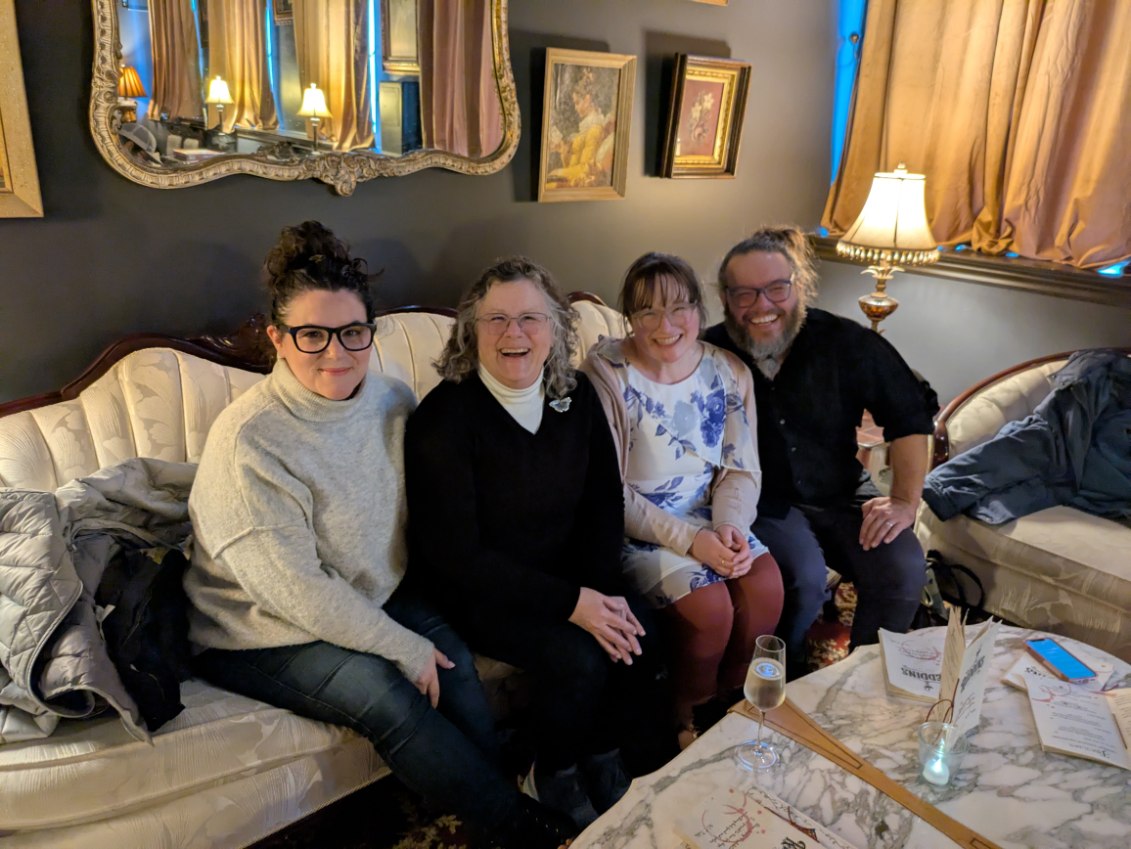
Photo of my sister, my mom, myself and my husband seated on an antique couch at a local speakeasy, Reddins
At the same time that I got to spend time with them, I was aware of the devastating cuts that have passed the House and could potentially pass the Senate of the United States in the guise of a “big beautiful bill” that will actually take away the protections built into our constitution (in irrevocable ways) and steal essential resources, including environmental resources, from the poor and middle class to give tax breaks to the wealthy.
If I had allowed myself to focus on the potentially horrendous future ahead of us, I wouldn’t have been able to enjoy my time with my family. Thankfully, I’m well-practiced in mental fitness techniques, and even with the extra stressors that can pop up when interacting with family (due to old childhood patterns) or in being in new environments, I felt very equipped to enjoy my time with them.
So today, I thought I’d explore the saboteur that can often be at play when navigating these challenging times, as well as some ways to combat those thoughts and patterns as they arise, in hopes that it can help you too.
In the words of Positive Intelligence, “Saboteurs are deeply ingrained patterns of thinking and behavior that limit your potential and hinder your ability to perform at your best. They are internal critics that operate based on fear, self-doubt, and negative self-talk. Saboteur patterns can take various forms, such as the Avoider, the Hyper-Achiever, the Victim, and more. Each Saboteur has a unique way of sabotaging your wellbeing and success.”
Vigilance itself can be a very wise characteristic. Businesses, individuals, families, and other organizations benefit from people with the skill to be paying attention to future possibilities and preparing for them in a wise way.
But the Hyper-Vigilant Saboteur is perpetually alert, constantly scanning the horizon for any threats and anxious about what can go wrong. The Hyper-Vigilant Saboteur becomes chronically stressed, and by doubting yourself and other people, the saboteur makes sure that you aren’t able to be present, relax, or enjoy the present moment.
While these saboteurs originated as a way to protect us and keep us safe in childhood, when we overly rely on one type of behavior, it becomes disproportionate and gets in the way of our ability to enjoy life and to be efficient and effective. The Hyper-Vigilant Saboteur can look like the “boy who cried wolf”, getting anxious about EVERY possibility and potentially missing the true, actual dangers that deserve our focus and attention.
A 24/7 news cycle is built for those of us with a strong Hyper-Vigilant Saboteur. The news media focus on the negative and seize on our fear to keep us watching, reading, and tuning in. This makes us suspicious of other people and question our own safety and our own ability to weather the storm. You may feel skeptical or anxious or even constantly worrying thanks to this saboteur.
If you find your own anxious thoughts getting in the way of your ability to enjoy your present company, there are a few things you can do to help the situation:
When you catch the anxious thought patterns repeating themselves, stop and let those negative thoughts go. Recognizing that these are your saboteurs and your saboteurs’ limiting beliefs is the first step. (This is what we study and practice in my mental fitness programs.)
Take a ten second break to hyper-focus on your senses. This is mindfulness, but with extra focus. Feel the sensation of the wind in your hair or observe the inhale and exhale of your breath. Command your mind to be fully present on the colors or textures in front of you. (I teach some of these techniques when we complete a Saboteur Assessment. Consider joining me!)
Here are some other ideas for conquering your Hyper-Vigilant Saboteur:
Practice mindfulness – take a walk, meditate, do a body scan, mindfully enjoy a drink or a meal
Practice being present and discerning between true threats and the dangers you perceive. Take a breath and pause before deciding how to proceed in each situation
Find ways to challenge worst-case scenario thinking: consider alternatives, consider what’s likely,, or even follow your worst-case scenario thinking and then imagine how you’d handle it or how realistic that is
Ask a friend, or a coach, or a therapist for support and their perspective
Move from worrying and anxious thoughts to taking meaningful and specific actions
Though by adulthood, the neural pathways of our saboteurs are well-worn and well-honed, we can learn to create new neural pathways and build new habits using the wiser part of our mind. We are more than our saboteurs. And the more we do this work, the more joy we can find in the everyday moments, like a meal with those we love.
Friends, I am disgusted and fearful and angry and sad and more when I read news headlines or simply think about how many children and adults are suffering and whose rights are being stripped away.
I just called my senators to oppose Casey Means for Surgeon General. I will keep calling my representatives to hold them accountable each week. And I will spend a little time each day being open to the best ways that I can make a difference in the world.
But you know one of my favorite things in the world?
Sunlight.
Photo of a happy dog running down a path by Pixabay
A sunny day, with blue sky and mild temperatures, is such a gift. And in our part of the world, I am getting more and more beautiful sunny days to enjoy. Spring is a beautiful time of year. I’m watching tulips begin to bloom, and watching bumblebees and honeybees at work. Friends are beginning to share the bounty of their gardens with us. I’m taking more joy (and less layers!) on my walks.
While I know there are plenty of people in the world, like my husband, who struggle to deal with the heat that the sun can bring, we know the sun isn’t just a beautiful gift for us. It’s also essential to life. Without the sun, plants and nature can’t do its job, and our food supply would be at stake. We’re all so interconnected, and the sun is an essential piece of the puzzle in our lives.
You may also be feeling stressed. You may feel pressured by some saboteurs in your minds. Perhaps you’ve got some thoughts popping in on the regular, telling you that you can rest AFTER you achieve your next goal, or hit your next financial milestone, or finish doing ______.
I want to challenge you to ignore those voices. Be here NOW. Enjoy the sun as it comes through your window or touches your face. Smell the flowers. Savor the feeling of a breeze on your face, or the wind in your hair. If you are a gardener, enjoy the cool soil between your fingers, or the delicate seeds and plants you cultivate, or the glistening water as you water a flower.
We have no idea what’s coming tomorrow. If habeas corpus is eliminated in the United States, none of our rights to due process are safe. That could mean we’re also rounded up and imprisoned in the days or weeks or years to come. We can try to fight it, but it’s something much, much bigger than just us. The fight may or may not be successful.
So what can you do, in the face of uncertainty? In the face of possible peril?
Be here now. Enjoy the sun. Savor that slice of cake or a moment or play or joy with loved ones. And remember that rest is also resistance. Life is a marathon, and not a sprint. Keep tuning in to where you are, and appreciate all of the nuisances, details, and even fun that it offers.
Take good care. Enjoy the sun.
Want to learn more about the saboteurs getting in the way of a more efficient, effective, and happy life? Let’s talk.
Looking for a speaker for an online or in-person event? I’d love to hear from you, or have you recommend me to a friend.
Feel yourself wherever you are. Whether you’re standing, sitting, lying down, feel yourself on the surface you’re on. Touch an object (maybe try this device?) and observe the temperature and texture of it. Notice fine details you haven’t noticed before.
We are still here, friend. Let’s celebrate the little wins. You made it to today.
Photo of a monarch butterfly on a branch by Erik Karits
As much as there continues to be more horrendous news, I am seeing signs of progress regularly this week in the fight toward defending human rights and preventing more atrocities. Read on for more of the progress I am seeing ( in the United States, predominantly), if that interests you. And if not; go find some joy, and keep breathing! You’ve got this.
More signs of progress:
The unelected billionaire seems to be displeasing the Rump – or at least, seems to be leaving the prominent position he’s in. While I don’t trust any of that being simply face value, I am happy for signs of tension in that relationship. Cautiously optimistic, I’d say.
A great win in the courts in Montana this week for transgender and intersex (and any gender-noncomforming folks who might also be persecuted) folks in Montana. Their extreme bathroom bill was struck down!
Wisconsin’s election was NOT bought by Elon. His $25 Million could have gone so far, but instead he threw it at a candidate who was resoundingly defeated.
And while Florida’s election for two house seats was still easily won by Republicans, it was a MUCH lower margin than in November. Progress.
I’m also hearing more and more horror stories making headlines about visas being revoked. So while it’s disgusting that students and professionals alike are being deported or told to self-deport due to having an opinion the government doesn’t like, I’m heartened by how much people are talking about it and making noise about it to their reps.
And of course, I have to shout out Cory Booker, who spoke on the floor for more than 25 hours to make “good trouble” and make sure we know and understand that this administration is NOT normal and it’s NOT okay.
As I walked outside today before writing this, I enjoyed a gorgeous blue sky. I’ve recently booked another speaking gig and gotten myself a new part-time job I am thrilled about in addition to the beautiful mental fitness, coaching and Enneagram work I am privileged to share with the world.
I hope that whatever your own situation is, you’re finding signs of progress too. And if you have one, please consider sharing it with me!
Take care, and keep fighting the good fight. And remember, rest is resistance. Find joy. Be love. One step, and one day, at a time.
Curious about working with me? Want to learn more about what’s keeping you stressed or stuck? Book a saboteur assessment here, or learn more about the Enneagram here.
In the world we’re living in, with politics and climate change and humanitarian crises filling our brains and our neighborhoods and our news feeds, I could not be more grateful to be nearly three years into my mental fitness training. What began as a curiosity after six months of intense work to reign in my growing anxiety turned out to be the missing tool in my client work and in my own mental health, and I couldn’t be more thankful for it – especially right now. Today I’d like to share how I found mental fitness and the difference it’s made in my life.
Photo of a person with a cloth headband and simple dress with their back turned to the camera, looking out at a beautiful nature scene by Anastasia Shuraeva
Until my mid-thirties, I didn’t believe I suffered from anxiety. While I was diagnosed with and treated for “depression” as a busy early teen who’d started falling asleep in her classes and after school (in part due to the side effects from my allergy medication), I did talk therapy for a year and was told I was fine, basically, and the sessions stopped, because I was no longer falling asleep all the time and seemed functional and able to handle my activities again.
My life up until that point involved a major identification with the word “busy”. When asked how I was doing, I said I was busy. I was in multiple theater productions (my record was three at a time), taking piano lessons, starting clubs and singing in choirs. I stopped dance lessons mid-way through eighth grade as my theater passion took over (and I’d recently given up dance competitions, which is another article unto itself), but I had added voice lessons into the mix by high school and was also required to participate in three sports or athletic programs each year at the private day school I attended.
So yes. I was busy. And this identification with the word “busy” continued through high school, into college, and into my twenties, where any feelings I had of overwhelm or extra adrenaline or a racing heart etc. were labeled as “busy” at best and otherwise ignored. And when my body started showing signs of chronic health conditions, I pursued diagnoses for physical conditions without recognizing that there might be mental conditions worth exploring too.
It wasn’t until I figured out how to support my husband’s dream (traveling as a touring musician) by having the two of us buy a used RV and travel the United States that things started to shift. I relied on adrenaline and discipline and problem-solving to get through the transition, even in the face of my newer symptoms of fatigue, but by the time we’d been on the road for six months or so, things began to shift. Without a theater company to run, with minimal lessons to teach and nowhere to physically be (unless we wanted to), my mind began to open up, and I found myself asking questions I hadn’t really delved into deeply and from a wise state of mind before.
The questions looked something like these:
Why have I been so successful as a creative, and yet I’ve never earned more than $50,000 in a year?
What are my beliefs around money? Around success?
Where do I want to be in ten years? In twenty?
Who am I if I’m living a simpler life?
What does community mean to me?
Who are really my friends? Who are the friends who believe in me, even when I don’t have anything to offer them but my friendship?
As I began pursuing personal development for the first time, through programs and books and podcasts and an accountability group, I also was living with my husband in very close quarters on a daily basis for the first time. As he worked through his own mental health challenges, I started to see signs that I may also be living with anxiety for the first time. I began occasionally getting panic attacks – and they’d be triggered by my husband’s own struggles to regulate. I began to see with clarity my own signs of codependency and my struggles to maintain boundaries and protect myself from taking on other people’s emotions.
In the midst of these studies, COVID hit, and as Ross and I were prepping for a move to Canada in light of the uncertain political situation and fears that we wouldn’t be able to maintain a unique lifestyle that we loved if we lost our rights to affordable health care and control of our own bodies, we learned to work through new fears and anxieties for the future.
My body and mind were incredible to me during this time. I was working more hours than ever in my online businesses at the same time that I was overseeing a move to Canada, which felt like a fulltime job in itself.
Is it any wonder that by the time we got settled into our new Canada apartment, maybe two months in, my anxiety kicked into overdrive?
I finally felt safe, settled, and like I could relax. We’d gotten what we’d worked so hard for. We’d even crossed the border when such travel was still very restricted, especially on Prince Edward Island. And with this sense of safety and calm, my body said, ‘FINALLY!”. My anxiety rose to the top and spilled out all over the place. It was something like the way athletes get sick after the big competition or students and teachers get sick on vacation.
I was having several anxiety attacks a week. Driving became especially triggering. It was when I noticed it was starting to get in the way of my work that I sought professional help. I went to a mental health clinic and got on the list to see a psychologist. I signed up for Betterhelp to have a more affordable option than the going rate, and I went through one mediocre therapist on that platform before finding someone who had a lot to offer me. After several months on the wait list, I saw an in-person psychologist on PEI’s dime, who unfortunately didn’t seem capable of helping someone as high-performing as me. (She didn’t know what to do with me. Sound familiar to anyone else?) I completed a local anti-anxiety program called ICAN, which gave me excellent practice with anti-anxiety tools like body scans, 5 4 3 2 1, breaking anxiety-producing tasks into smaller pieces and many more.
In other words, I had a ton of support, which I’m grateful for. And I am sure it all helped, especially the anti-anxiety program, to get me through the worst of it. As I did the work, I started to observe myself going weeks and eventually even months between panic attacks.
And then, thanks to a fellow life coach, I discovered Positive Intelligence.
I took advantage of a free program for active coaches. Seven or so weeks of training in mental fitness, led by coach Shirzad Chamine and based on the most cutting edge science and research. We were required to maintain an accountability group and do daily check-ins with each other as part of the process, in addition to weekly group meetings over Zoom.
I entered the program skeptical that anything free could be that transformative. But I was soon a convert. My husband noticed differences in me too. When it ended, I knew I was signing up for further study and to begin training so I could bring mental fitness into my coaching practice.
There’s a lot about Positive Intelligence that resembles the personality study I’d been doing using the Enneagram since 2019. But there are a lot of distinctions too. While my Enneagram work had shown a brilliant light on where I was trapped in patterns of behavior, I hadn’t made significant progress in improving that behavior and growing toward a healthier way of being. (I had, however, developed a lot of compassion and understanding of how to be in better relationship with my family and friends and my husband – some major wins!)
With my new mental fitness tools and a daily commitment to practicing them (thanks in part to the genius Positive Intelligence app included in my study), things started to improve for me really quickly.
I became calmer in the face of stress. I became less likely to get triggered by my husband or a family member or a member of my chorus. I became better able to tap into a wiser, bird’s eye view perspective of my life. I became happier, more easygoing, and a more effective coach, partner, friend and family member.
And over and over again, my clients who chose to study mental fitness with me also were reaping the benefits. They became less reactive, more able to handle grief, better able to get things done (from creating and living by a budget to making phone calls or regulating their own anger and anxiety).
For me, and for so many in my work, mental fitness has been the missing piece. Instead of continually watching themselves repeating patterns but struggling to break free of them, they were able to be more effective and efficient, spending more time in that wiser part of their brain and quieting the negative and sabotaging parts of it. They were happier. And they got to benefit from a more healthy and regulated coach better able to guide them.
With hindsight, I can see that the big piece missing in my own Enneagram studies in the first several years was a commitment to a contemplative practice. At most, I’d dabbled in meditation, and while I went through periods where I got out in nature daily while we were RVing (often for hours at a time), I didn’t recognize it for the meditation that it was, or that it could have been, if I’d taken the podcast out of my ears and really tuned in to my surroundings. Until I joined Enneagram trainings and workshops (rather than simply reading books or listening to podcasts), I wasn’t clear on how essential it is to pair Enneagram work with meditation and other tools. By the time I began doing that that, thankfully, I’d incorporated Positive Intelligence into my life. All of sudden, I was growing mental muscles. My mental fitness and Enneagram work began to support each other.
I remember a few years back, sharing with delight an incident from earlier in the week with my first Enneagram cohort.
At the time, I had a plastic bin next to my bed, and on it, I had a humidifier. I also had a variety of different possessions, including a book, as I was using the bin as a night stand. On this particular evening, I’d fallen asleep and reached over to grab something, and I hit water. Everywhere. Everything on the stand was soaked.
Prior to my Enneagram or mental fitness studies, I would have been hit with a wave of self-revulsion for having made this mistake. My inner critic would have kicked into high gear. And then I would have been angry, jumping into action without stopping to think and cleaning all of it up myself. If at some point down the line I had thought to ask my husband (who was still wide awake) for help, I would have done so in an angry, frustrated state. When met with that heightened, angry and panicked state, my husband would have responded with his own saboteurs, and I know from past experiences this would have led to us both triggering each other and lengthening the process until we could each calm down, forgive as needed, and come to bed and fall asleep.
Instead, I felt the water, realized I was very close to sleep and didn’t want to wake up and ruin that, so I called out to my husband.
“Ross, can you help me with something?” I calmly asked. He came in, happy to assist, be helpful, and answer my calm request. I explained the situation and asked if he could help me since I was almost asleep. He agreed. Given that he struggles in those moments to know what to do, I then began making requests. “Can you go get a towel please?” “Can you put this over there?” I talked him through it, but did so calmly, lying in bed, and trusting him to figure out details of where to hang towels or set items to try.
And when all that was done, I simply rolled over and went back to sleep.
Nowadays, even in the face of this wild rollercoaster of a world, I am extremely grateful. For calm. For days where I am seldom, if ever, thrown off. Even in the face of hard things, it’s the rare day when I have to work hard to stay regulated. I’m able to preemptively do my mental fitness exercises long before a panic attack. And I am healthier, kinder, and more whole in my responses to the world.
Do you have a mental fitness practice? Want to learn more about the saboteurs that are keeping you from living your best life, day in and day out? Imagine what’s possible for you in your relationships, your career, and across your life with this change! It’s never too late to find more joy in your life.
I’ll be honest. Some years, I feel super inspired to reflect on the year that’s passed and plan ahead with some goals and perhaps a word of the year for the year to come. But this is one of those years where I haven’t really been feeling it.
I think it’s because I’m tired. I’ve been focusing on resting and healing as much as I can lately after a very busy holiday season wrapped up, with a total of 8 performances (plus countless rehearsals) for various musical organizations I’m a part of in some form.
While this hasn’t looked like lounging on the couch much, it has seen me organizing my apartment and enjoying the process of decorating or decluttering. And yes, that kind of external work can be healing for my inner mind as well, though I know that isn’t true for every personality out there.
So here we are, New Year’s Day, and while I had been considering skippingb a post until I felt inspired, last night I felt myself interested in doing some reflection for myself (finally!), and I figured if I’m going to do it for myself, I might as well share some of my process with you. Perhaps it will be the inspiration you have been looking for – and if not, perhaps you’ll find something else useful to take from it.
For the past many years, nearly seven, I met weekly (or so) with a marvelous group of humans I met in an accountability group online. One of my favorite practices with this group was reflecting on the year that had passed and making plans for the future.
I’m going to teach about this process live today in my Facebook group, Crafting Your Life Adventure, but if you want to walk through it on your own, here are the highlights:
Using meditation, music, or your other favorite tools, tune into your body and clear your mind to set the table for reflection, without judgment or criticism of yourself. The goal is observation and celebration, and to let the wise part of you drive the bus.
In a journal or another safe and accessible space, list all the things you accomplished this year. Consider all the areas of your life, such as family, friends, career, home, personal goals, hobbies, spirituality, physical health, emotional health, new habits, even media or books consumed. Accomplishments don’t need to be physical, and they don’t need to be “measurable” in the traditional sense. Did you make any new friends? Did you survive another year? Did you do something you were afraid of? It can be helpful to ask a loved one we trust to help us do this with compassion if we struggle to recognize our own value or remember our own accomplishments.
Review any past lists of goals you’d set for this past year, and with gentle observation and no judgment, observe any progress you made toward those goals. If you didn’t get there, what obstacles did you hit? What lessons did you learn along the way?
Consider what you’d like to accomplish in the upcoming year. Sometimes, before I do this step, I dream up where I want to be in five years, or ten years. And that can help me get attuned to steps I want or need to take in the next year to make that happen.
As you dream up your next year of goals, again consider all areas of your life. Make sure you are tuning into YOUR goals, not society’s goals. If you don’t care about losing weight, why would you focus there? If you like renting instead of owning a home, awesome! Choose goals that are meaningful for you, with your own priorities in mind. Again, keeping sight of your goals for the future can help you here.
Consider if there’s a word that will sum up the spirit of the year you’re envisioning for yourself. Past words for me have included “Trust” and “Abundance”. Elizabeth Ryder does a lovely job of explaining how and why we might choose a word for the upcoming year. (And remember, you can always change your mind! It’s just a tool to help you remember your own goals in the busy world we so often get caught up.)
Consider working with a coach or reaching out to a friend for support if you want further clarity or a mirror for your own goals.
Consider finding a friend, coach, or joining a group for accountability in the coming year. (I lead several groups in this vein, and the new year is a great time to find one. Contact me to learn more.)
Want to start the new year off on a new foot? Why not schedule a Saboteur Assessment to learn more about what keeps you from your goals to help you feel more joy and become more effective in the new year?
When you feel complete in this process, find a way to let go of the past year and welcome the new year. It could be with a prayer or intention, a lighting of a candle and blowing it out at completion, or repeating an affirmation. A great thing to do is to end your reflection and goal-setting with gratitude for what was and for the lessons that came from it.
It’s never too late to do this type of work. Do you have a reflective practice at year end? Do you have goals for the upcoming year? I’d love to hear about it! You can comment or share with me in my Facebook group.
Congratulations on getting through this year. I’m very proud of you. I hope you are too. Wishing you all the best in the year to come.
P.S. I still have space for a few more participants interested in learning more about themselves and the patterns of their personality (and how to break free of them) using the Enneagram. Reach out to sign up, or join me for an intro!
Photo credit: photo of an evening with moon, tree, and water reflection by Pixabay.
One of my favorite reads this year has been The Myth of Normal: Trauma, Illness, and Healing in a Toxic Culture by Gabor Mate. It’s a long book, and I’m still working my way through it, but it’s the most comprehensive acknowledgement I’ve found of the complex factors that make our lives challenging as well as the varied ways, from individual to systemic, that healing is possible for us.
In the book, Mate refers to the concept of healing as a journey toward wholeness:
“It is a direction, not a destination; a line on a map, not a dot. Nor is healing synonymous with self-improvement. Closer to the mark would be to say it is self-retrieval.”
Self-retrieval.
What if we could find ourselves again? What if we could work through the suffering, make some changes, change our perspective, and ultimately return to ourselves?
To the beautiful self we were before the world hardened us, changed us, wounded us?
To the wise, sage being underneath all those layers of personality we put on as self-protection?
To the sweet, kind human obscured by our saboteurs and our sabotaging thoughts?
What would a journey of self-retrieval look like?
Conventional thoughts around healing might make us focus on the physical path toward healing: get some rest, take some medicine, eat some healthy food, get some exercise or movement into our day.
But if we’re on a journey of self-retrieval, that kind of healing would also include our mental and emotional needs. Maybe that’s therapy, spiritual development, coaching or yoga. Maybe it’s art-making or finding joy, fostering meaningful friendships and connections or joining support groups. Maybe it’s an afternoon with tea and a journal, or pounding a pillow, or grieving the loss of a loved one or an opportunity or a career that could have been.
One of my coaches emphasizes the importance of play – finding joy in the things we once did as children, or the things we wish we’d have had the opportunity to do as a kid. So for me, self-retrieval might mean cultivating play: purchasing a jump rope, swinging on a swing, coloring in a coloring book, or dancing around my living room or in a dance studio.
What does healing as self-retrieval mean to you?
My Enneagram teacher, Suzanne Stabile, has a book called The Journey Toward Wholeness. I recently re-read it with a cohort of other students of the Enneagram. The conversations have been revelatory. The Enneagram remains my favorite tool for self-retrieval or healing.
It’s so easy, amidst a busy day and week and life, to stick to the status quo and say no to new opportunities. But as Suzanne says in her book, “Even when there is much to do, we must first guard our souls.” I highly recommend joining an Enneagram cohort (my next one will start in the new year) or, if you know your number, a group like my Enneagram Book Club, to further your own work toward self-retrieval.
Do you agree with Gabor Mate, that healing can be seen as self-retrieval? Does this have any implications for you in your own journey?
If you’re feeling a lot of emotions or going through changes in your life, now might actually be the best time for you to seek a community as you navigate your healing journey. And wherever you are in the journey, I wish you all the best.
I’ve always found myself caught between two sides of myself in keeping my place organized. One part of me is an aspiring minimalist, with a keen awareness of the gift of calm and peace I feel in a clean, tidy, and simple space. Other part of me is a pack rat, wanting everything organized in its place but seeing a need to hold onto everything, and with a brain so busy with activities that I seldom want to stop and tidy up.
If I put much (read: any) weight in astrology, I might ascribe this to being a Gemini. I do put some of it up to my nature as an Enneagram 1: my perfectionist tendencies are ingrained habits and coping mechanisms from way back in my life. In my mental fitness work, this would be my stickler saboteur coming out to play. Like so many 1s, we want structure, but we also rail against it, especially when it seems like no one but us knows how to do it correctly. Aren’t brains delightful sometimes?
Regardless of the habits or emotions you find popping up related to cleaning and decluttering, I love this tip I gleaned and shared in the midst of a decluttering phase early in COVID:
When you’re decluttering, always start with the most visible clutter.
It’s not rocket science, but how great is this suggestion? If guests enter your house through the front door, that means EVERYONE will get that view, even if they’re just popping their head in to pick up a package or drop off a meal.
So when you’re ready to declutter, always start with the most visible clutter: you know, the stuff you can see when you open the front door to come inside.
You know the brilliant thing about this tip though? It applies to both decluttering and to our daily lives in general.
In the physical realm, if we start with what’s most visible, we’ll see progress immediately, and even if we get distracted from our task, if someone shows up at the house, they’ll immediately get a cleaner view than they would have otherwise.
In the same way, if we’re feeling overwhelmed by all of the tasks on our to-do list, one helpful method is to start with what’s most visible. If there’s an item that’s been on our list, haunting us, for two months, knocking that thing off the list a) means we won’t be wasting any more brain space or time worrying about getting it done and b) means we can knock it off the list. Chances are that it was taking up more than its fair share of space, and having that done will be super helpful.
Likewise, if I’ve got a million things to do, but I keep putting off making a priority list, that’s the most visible thing that will be a huge help. If I do that first, I’ll be able to see the items that are essential and urgent and prioritize them accordingly. If the most visible thing is that I haven’t updated the family calendar or made the doctor’s appointment that’s required of me, maybe it’s that. But the same idea holds. Consider what’s most visible, or most present, and start there.
While my mental fitness work has me in a pretty great space right now, anxiety is always an old habit my brain can hop to with ease. When there’s extra on my plate to navigate, anxiety means that clutter that normally wouldn’t bother me can feel overwhelming. (I ignore the inner critic and judge in my head under great circumstances, but if I’m tested enough, the anger can say hello! Yes, I’m a textbook Enneagram 1, and my strickler and judge saboteurs are especially strong, and these patterns will always be available to me if I let them.) But the flip side of it is that when I make some time to declutter, I feel palpable relief, basically immediately, and my anxiety gives me a break for a while.
While the visible clutter isn’t always actually the most important thing on our list, it can give us the mental capacity to tackle other things on our list.
If your email inbox is freaking you out a little bit on the daily, it’s time to set a timer and do a bit of decluttering there.
If those dishes are taunting you while you’re trying to work on your side hustle, it may be more effective to do those first, or at least delegate and pass it on to another family member.
Don’t underestimate the power of tackling that visible clutter. And the reverse can be true as well. If you start with the invisible clutter (you know, the stuff in your cabinets), you won’t get the visible satisfaction of seeing and showing off your progress after a decluttering session.
Likewise, the invisible brain clutter may include tasks that, while nice to tackle, are ignoring the elephant in the room, or your brain, metaphorically speaking.
So, I challenge you – tackle some clutter this week. Physical or otherwise.
If you’d like to learn more about the sabotaging thoughts in your own brain, getting in the way of your own projects as you aim to create a life you love, let’s talk! I offer a free saboteur assessment, and you can learn more about it and book a time here.
Thanks for reading, and have a great week!
P.S. Grab a copy of my Four Steps To Your Dream Life Blueprintwhile you’re at it. Giving yourself the gift of organizing and transforming your future is one more way to declutter and grow!
This article is based on an article I originally published on February 5, 2021.
Do you consider yourself to be a religious person? Or a spiritual person?
It’s something that I’ve struggled with somewhat for as long as I can remember. I’ve always wanted to have faith, to have a certainty or sense of knowing or trust about what’s coming.
I grew up Episcopalian, aka mainline Protestant, aka Christian, in a fairly liberal, “low” church that saw more diverse families than I ever saw in my classes at school. It wasn’t unusual for our pastor (a woman) to have us dance around the church, singing a song that wasn’t in our hymnal, or have us engage in discussion groups during worship.
Nevertheless, even with her occasional elaborations and interpretations of the beautiful Episcopal prayer book, I still grew up with a fairly “by the book” religious education.
Going through confirmation classes, I did my fair share of questioning, but I’m also a rule follower, so it didn’t occur to me to do anything but complete the classes and get confirmed in the church.
When I went to college, for the first time I felt like I had a wide variety of options for where and how I would worship. Some of my friends became Pagan (intriguing, though it never occurred to me at the time to seek it out), but after trying out an Episcopal church service in town (nice, but nothing too memorable for me), I found my home at our college Protestant services.
These ecumenical services brought together students and staff from very diverse backgrounds, and they were designed to give everyone a little taste of the familiar. So we’d sing a “traditional” hymn or two that I might have sung growing up, and we’d have a praise and worship part of the service, led at the piano by our Black pastor who had grown up in the African-American Baptist tradition and gotten his bachelor’s degree in music. For that section of worship, there was no need to hold the hymn in our hand – the pastor would call out the lyrics and we’d follow him for the cues.
There might also be another hymn or two from a different hymnal, and perhaps we’d have a guest performer, and every other week, I’d sing with the gospel choir, where I was usually the only white singer and learned every song by ear – an incredible contrast with my strict, traditional, white, Western music education. It was a wonderful immersion in another culture and a new experience for me.
I’d stand on the stage with the choir, singing gorgeous music that filled and uplifted the space, and I’d be in my element. Afterwards, people would come up to me and say how transformed they were by my solo, or how much they enjoyed our performance, how moving it was.
I always wished it would move me that way. I felt like something was missing, something was wrong with me. To be fair, music did sometimes give me glimpses of God, just brief moments, when all the musical parts would come together perfectly. But otherwise, I’d always feel like there’s something wrong with me. Jason Robert Brown describes it well when he requests, “Let the music begin.” and “Longing to feel what you feel…music of heaven to open some path to your soul and let something glorious in” in his song “The Music of Heaven”.
After leaving the utopia that my bubble of a college experience was in many ways (definitely lots of privilege there), I spent the next year traveling the country with a children’s theatre, followed by a few additional years of searching when I settled down in New Hampshire. In weeks that I had some flexibility on a Sunday, I made a point of checking out a local church (in hopes of finding the connection I’d been seeking). I enjoyed the contemporary Christian experience from a music standpoint, but I found it didn’t resonate with me in terms of beliefs. I found lots of mainline Protestant services that reminded me of home (similar, but different), and I got angry at the Catholic church a couple of times. I also had a couple of truly frightening interactions that I won’t get into here.
Later, I found a ton of satisfaction as the accompanist at churches I found a home and community in. I loved the communities I worked in, and in addition to those occasional transcendent music moments, I was delighted to help other people find those connections to God through my music.
In more recent years, I’ve loosened up my definition of spirituality. Maybe I’m never going to feel that clarity I’m seeking every Sunday. Maybe it’s more a question of creating a practice of contemplation, where I seek wisdom, get in touch with my inner knowledge and seek connection with the universe. I connect with nature. I read. I engage in challenging conversations. Creating sacred time for myself each morning has evolved into one of my favorite things about my day, and I’m so thankful to have a morning routine that truly lights me up and makes my day better. I’ve also been getting to know my local Jewish community, an aspect of my heritage I was rarely exposed to as a child.
Working with my clients, I’m finding it’s really important to encourage them to take time for themselves to check in and be still each day. We all need that time for ourselves, and the consistency of a morning (or evening) routine offers us so many benefits. For some it’s meditation, for others prayer or reading and journaling, but it is essential.
Do you aspire to have a consistent morning practice? If you’re working to create the life you want, it may feel daunting to acknowledge where you are now compared to where you want to be. I encourage you to take one small step today to get aligned with your dream life.
Does the dream version of you make time for a prayer each morning? Practice gratitude before bed? Take a walk outside? You may not have the car of your dreams, or the abundant bank account, or the dream schedule or supportive friends or loving partner, but I’ll bet there are steps you can take today to make your present more like your future.
So while spirituality or religion isn’t a requirement as you create your “dream life”, or a life that you love, it’s important for all of us to have some grounding practice that centers us each day. And honestly, sometimes even very religious people, or those who appear so on the outside, aren’t taking enough time to do the work on the inside.
If you’d like help with this, let’s get on a call to discuss how I can help you get there.
Do you have a sacred practice? Does it light you up? What’s one change you can make this week to get you even more aligned with your future and best self?
This is based on an article I originally wrote and published on December 11, 2020.
I love my mornings. And part of my morning practice most days involves contemplative reading of some kind.
Today while re-reading an Enneagram text I stopped at a quote by Henri Nouwen: “We cannot suffer with the poor when we are unwilling to confront those persons and systems that cause poverty. We cannot set the captives free when we do not want to confront those who carry the keys. We cannot profess our solidarity with those who are oppressed when we are unwilling to confront the oppressor. Compassion without confrontation fades quickly to fruitless sentimental commiseration.”
I found this to be an important quote to consider. I even challenged my social media connections, asking them “What’s one step you can take today to confront the oppressor?”
My spiritual studies, especially my Enneagram work, has been so life-giving.
I’m excited to have heard from a few of you regarding the next Enneagram group program I’m leading.
You may be on the fence, unsure of what, exactly, the Enneagram is and why you should be checking it out. Is it a useful tool? An ancient cult? A TikTok trend?
If you’d like a taste of the Enneagram, in this workshop, you’ll learn more about it as and even get a taste of the different numbers and where you and your personality land. After the workshop, which you’re warmly invited to, I’ll have time to answer any questions you have about the Enneagram or how you can work with me in the future if you’d like to.
Learning about our personalities and why we do what we do is FUN. It’s also tough to explain the Enneagram in an elevator pitch, but it’s transformed my life as well as the lives of SO many more, so I’ve created this intro as an easy way for you to get a sense of it and whether it’s something you’d like to study further in the future.





 Crafting The Life You Want: A Practice in Living