It’s spring, friends. Even if it looks like winter or mud season or something else entirely where you are (summer?). It’s spring here. And spring is always a beautiful opportunity for a reset, a new perspective, and a fresh start.
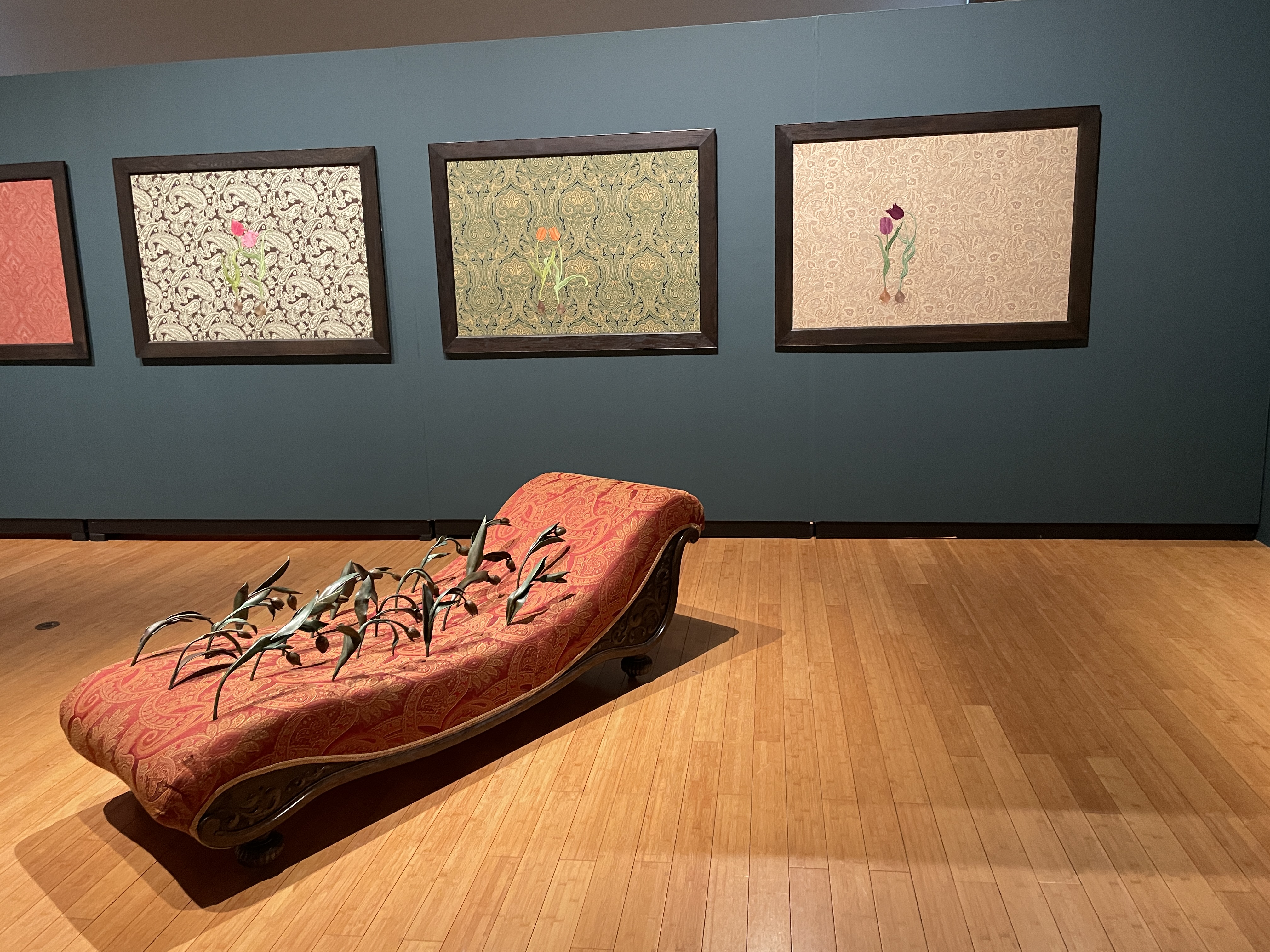
Photo: A glimpse of Sarah Maloney’s artwork. In the foreground is a piece of furniture (divan) with what look like metal plants growing up from it. Behind it are quilted panels with flowers embroidered on top of them.
I’ve been thinking about the way I plant seeds in my life. I imagine you could make your own list. Maybe you have a garden, and you plant literal seeds! Amazing. Goodness knows that as the price of gas and food continues to rise or fluctuate, and the world keeps changing, growing your own food is an incredible way to give yourself some additional security and offer you something to share with your friends and neighbors as well as your family. Plus it’s fun (for some people), and good for your mental health, and it’s physical activity too!
Much of the work I do as a vocal instructor and barbershop director involves planting seeds. We can’t make dramatic changes overnight most of the time. So I drop bits of education, I cultivate the soil, so to speak, laying down roots so that we can build a variety of skills that will ultimately culminate in beautiful performances and more polished and confident singers.
Planting seeds can also be a way to think about marketing! Trust me, I’ve learned from personal experience that you can’t just announce a program one time and expect that people will sign up for it. It takes a variety of methods to get the word out effectively, and if I want a program to come together or for a bunch of new mental fitness or coaching clients to find me, it’s essential that I keep planting seeds by sharing new content and posts that reinforce the opportunities and help my potential clients see the benefit for themselves in participating.
I’ve also noticed that often, I do some workshopping, so to speak, of an idea that I have out loud with several people before I do it. This could be seen as a type of seed planting too – although perhaps it’s planting the seeds in my own mind and body! If I talk about it a few times, and if it feels good in my body and my voice, and maybe if the reaction I get to it is supportive, maybe it’s time to go for it. (I am also aware that this type of workshopping is NOT something everyone does. I think it’s part of my personality as an Enneagram 1 (we’re verbal processors). How about you?)
I think we’re always planting seeds in our own lives. When we start learning a new skill, trying out a new hobby, a new attitude or way of thinking, we don’t reap all the benefits all at once. It takes time. The reason I try to practice voice every day is that if we only do it once or twice a week, we can’t make much progress. It’s hard to rewrite habits with that kind of a schedule. But if we do exercises and push ourselves a little bit each day, it’s easier to integrate new habits and to see the benefits.
If you’d like to plant some seeds for change and growth in your own life, joining an Enneagram group or completing a Saboteur Assessment can be a wonderful next step.
I don’t know about you, but I’ve been immensely curious about why I am who I am, and why I do what I do, for as long as I can remember. Certainly for the majority of my adulthood anyway.
Why do I naturally excel at some things rather than others?
Why are some tasks that seem so easy for me seem so difficult for many other people?
Why do I struggle to complete things, when some people around me seem to complete everything they start, no questions asked?
Why does my sense of what’s right and wrong seem so different from other people’s sometimes?
Why do I repeat the same patterns so often, even when I recognize that they aren’t serving me?
And this curiosity extends to other people as well as to my own self.
Why do THEY make ______ look easy?
Why do people do things that seem cruel or unkind from my perspective?
Why do THEY do _____ when I would never do that?
Why do people’s expectations of me sometimes seem impossible? Are we living in different worlds?
Why is so and so always so direct? Why are some people so passive-aggressive?
These are the types of questions that I may ponder from day to day or week to week. And they are the kinds of questions that the Enneagram has given me a vehicle for.
When I learn to recognize my own personality type, I also learn to recognize that there are other people like me in the world – but that’s only a minority of them. Most people in the world are actually a different personality type than me. And it’s not that they’re bad people. They just have a different lens and a different way of seeing the world.
I’m so excited this week because after much planning and coordination, my next Enneagram group is getting started in April! We’ll be meeting weekly on Tuesday or Thursday evenings (Atlantic time – seems like this will be a PEI group though we are over Zoom), and we’ll study Suzanne Stabile’s amazing Enneagram Journey curriculum together.
[Since we’re about to begin a journey, here’s a photo from a recent journey by car with a striking sunset. I took it through the windshield.]
In this program, you’ll not only learn your Enneagram number, with certainty, understanding, and compassion for what that means. You’ll also study the growth path specific to your number, offering you ways that you can begin to unwind and change the habits in your life that are no longer serving you.
So far, our group is full of some lovely women, from working folks in our 40’s to retired. And if you’re seeking your own community for self-improvement and personal growth, this is the last week to join us. Head here and reach out to me if you want to join the fun. It’s a three month program, and we’d love to hear from you.
Some wise people have said over the years that everything is either fear-based or based in love. In my mental fitness work, my coach has told us the same thing, reminding us that the wise part of our brain makes decisions out of love, while the saboteurs, the negative voices in our head, would have us make decisions out of fear.
As children, these saboteurs told us to do things out of fear of rejection, fear of abandonment, fear of death. And over time, we made that a habit. And those neural pathways are well-worn, with habits that are very hard to break.
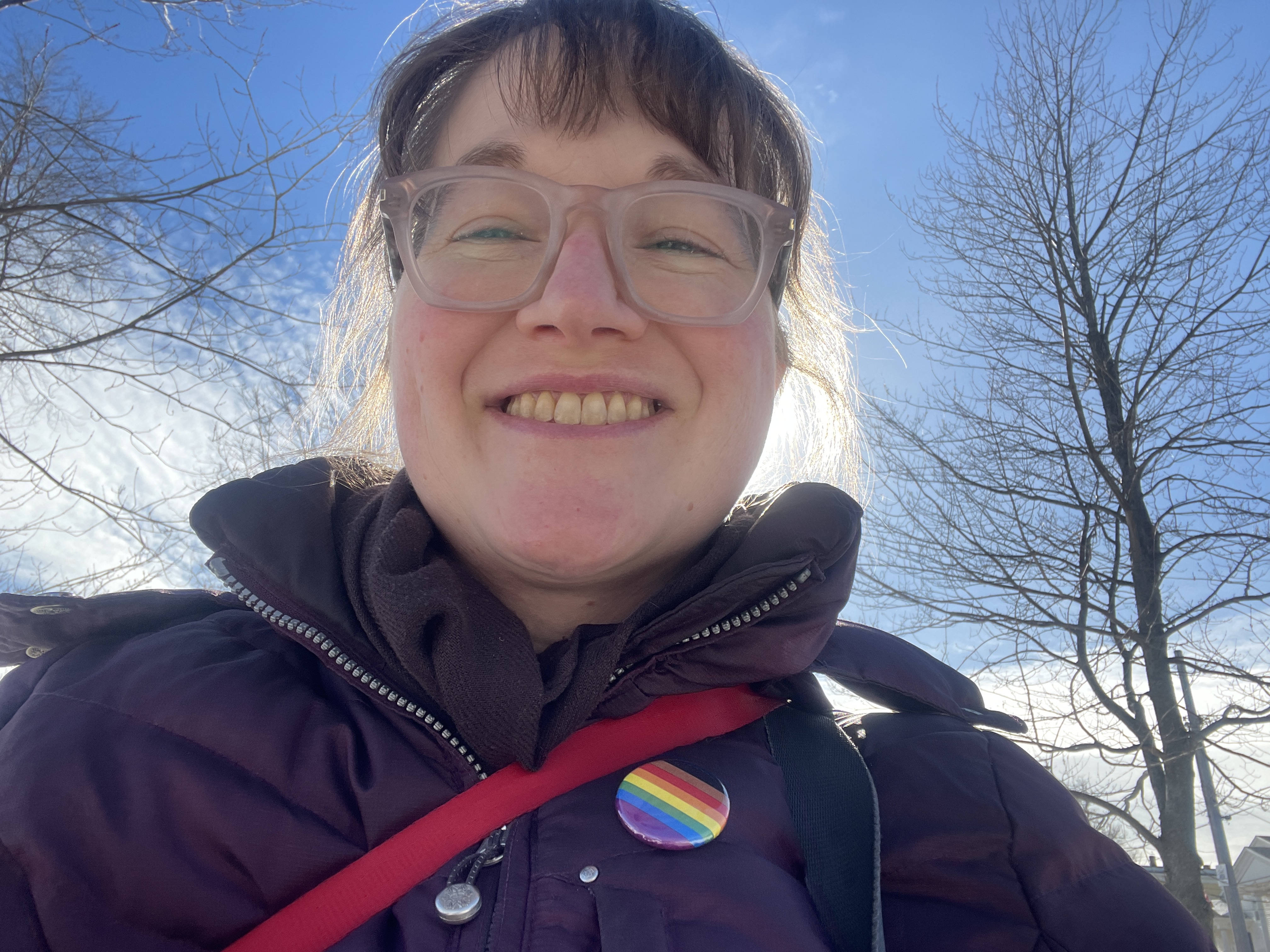
A silly, happy photo of me, wearing a purple coat with the red strap of a bag visible, sun and blue sky behind me, with a progress Pride button on my coat.
So, what’s the alternative? What does choosing love look like?
It might look like:
Listening to what someone has to say instead of reacting first
Responding with empathy or vulnerability instead of walling ourselves off
Exploring our options with a playful energy and a love for creativity or problem-solving instead of limiting ourselves out of a fear of lack and a longing for security
Getting ourselves outside or out in the world instead of letting our saboteurs dictate all the reasons for us to stay put or stay inside
Brainstorming with a goal of finding the win for ALL involved, rather than approaching each conflict as a potential win/lose or lose/lose scenario
Respecting boundaries, often of others, but especially of ourselves
Choosing love for me is often embracing curiosity. Embracing curiosity about why strangers might be doing things that I don’t expect or understand. Embracing curiosity about what would be possible, if I had no constraints or let go of my fears. Embracing curiosity about ways we can all find happiness, without taking it from anyone else.
So as I call my reps and support my neighbors and scream at politicians, I also work to pause. To breathe. Breathe first, and then respond, instead of reacting without a moment to process and ponder.
Where can you choose love?
And if this feels daunting, I have two beautiful ways that I support my clients which also can help you to find compassion, for yourself, your environment, and for other people.
My next group for people interested in learning more about the Enneagram begins in April. Join us on Tuesdays and Thursday evenings (Eastern/Atlantic time). Learn more hereand contact me, and invite a friend too.
And I’d love to support you in building your own toolbox to do this work. If you’d like to join me for an opportunity to learn some mental fitness skills and see how saboteurs are keeping you from living a life you love, head here.
Thanks for being here, and thanks for keeping at it, even when it’s hard or even feels impossible. You’re not alone.
I’d worked hard all day, and then I led a rehearsal that I was feeling extremely proud of. Under some challenging circumstances, we’d accomplished my goals, I’d adapted to the circumstances of the moment, and the feedback I received after the fact was all positive. I had so much to be proud of.
And yet, at day’s end, as I started to wind down and got into bed, I noticed a persistent thought – you could have done more to cater your rehearsal to people over Zoom. Surely you SHOULD (a word I normally try so hard to avoid!) have been able to do more dedicated engagement with the people who weren’t there in person. What if those people feel neglected?
I recognize that you may not have run a rehearsal or a Zoom session before, but regardless, hopefully you get the idea! Here I was, exhausted from a day of hard work, feeling accomplished after a very successful rehearsal, and the voices in my head couldn’t resist trying to put a damper on my excitement and chiming in.
Why does this happen? And is there a way to keep it from happening, or at least from derailing my day or keeping me awake at night?
Photo of trees and green grass, a sculpture at the end of a path, and a bench along it by Pixabay
I’m not a neuroscience expert or a psychologist, but I have become a very experienced mental fitness trainer, thanks to the brilliant tools and coaching I’ve received in the Positive Intelligence program. And while there are many ways of labeling or describing what goes on in our minds, however we talk about it, the good news is that it IS possible to tackle these voices.
I know from both my mental fitness training and my Enneagram studies that my personality, acquired for self-protection over many decades of life, but mainly my childhood, means that I see what’s imperfect and default to judgment very easily. While being able to see what needs to be fixed or what can be improved on serves me really well most of the time in detail-oriented work and in the rehearsal room, I have a judge saboteur in my head that often turns on me and my own activities. Here I was, having worked so hard and successfully, and as I tried to drift off to sleep, I had sabotaging thoughts telling me all the things I could have done better.
You may say oh, there’s probably some wisdom in that! Those sabotaging thoughts are useful!
But here’s the thing. While there may be some truth buried in what they’re saying, is it helpful to be beating myself up while I’m trying to drift off to sleep?
No. Absolutely not.
So how do we overcome those thoughts? Is there a more positive way that we could be talking to ourselves?
Yes, thankfully, there is. In the language of Positive Intelligence, we have sabotaging thoughts that come from our saboteurs. We can recognize the work of our saboteurs when we have persistently negative thoughts and emotions. Negative emotions are really useful to us. They identify something that we might want to pay attention to. For instance, when I first have a thought about what I might have done better at rehearsal, even if it makes me sad or frustrated with myself, the initial thought is useful. I can make a note about that for next time and do better. In 5 seconds, maybe 10 to have time to record a note to myself, the initial thought might have been useful.
But if, instead, my brain stays focused on judgment and tearing me apart, keeping me in negative emotions for a prolonged period of time, that isn’t helpful. That means my saboteurs are having a party and beating up on me. Instead, I have the opportunity to tap into my sage, wise mind.
While the habits of our personality, including those habits of beating ourselves up or judging others or the circumstances we are in, may be wired deeply after decades of use and building neural pathways, when we learn to focus our attention in specific ways, we can train ourselves to tap into the wiser part of ourselves. The wise part of my brain recognized that those negative thoughts weren’t helping me.
So what did I do?
I spoke what was happening out loud, to my partner, knowing they’re a supportive voice and would validate my own feelings and say something to the effect of “silly saboteurs, of course Jamie did the best she could. Nothing needs to be fixed right now. Let’s go to sleep.” This gave me extra encouragement to lean into my sage during a very vulnerable time for me (sleep time, when I am tired and extra sensitive to criticism and distraction after a long day)
When the sabotaging thoughts popped up, I changed my attention and redirected. I imagined the thought as a cloud that would soon pass.
I reminded myself of all the good things I’d accomplished.
I did some meditative and focusing exercises to help me to access the wisdom of my sage mind
Did it fix everything? No, not entirely. I had to repeat the positive thoughts and responses a few times, those saboteurs can be persistent. But to be totally honest, my sabotaging thoughts are much QUIETER than they used to be. I hear their voices, but they’re not as strong. They’re easier to block out. And that’s because I’ve been practicing mental fitness practices for many years. So I can personally attest to the fact that while this may feel really challenging for you right now, it can get better.
Did I get to sleep easily? Absolutely! And do I have additional tools I could have used if sleep was still a struggle? Yes, thankfully, I do, and I’ve loved sharing those with my clients as well. And when I am particularly tired and “out of spoons”, as many of us would say, those tools can be really important in conquering our sabotaging thoughts.
This has been a week, folks, for the world and maybe in your own life too. I hope that this concrete example of how we can overcome negative voices and habits in our mind is useful to you. And I’d love to support you in building your own toolbox to do this work. If you’d like to join me for an opportunity to learn some mental fitness skills and see how saboteurs are keeping you from being happy and living a life you love, head here.
Also, I still have acouple more spotsfor people interested in learning about themselves through the Enneagram. Understanding myself and my personality through this lens helped me to develop immense compassion for myself and for other people, and it truly changed so much about my marriage and family relationships too. I hope you’ll consider reaching out and joining us in the solitary work that is truly done best in community with other people.



 Crafting The Life You Want: A Practice in Living